Benjamin Merrill (1731-1771) and Jemima Smith Merrill (1728-1801) were born in Hopewell, New Jersey and married there about 1747. They then moved to the Jersey Settlement in Rowan County, North Carolina in about 1749-50. They had ten children. Benjamin had a large farm south of Lexington, and worked also as a gunsmith.
The British had imposed a harsh system of taxation on the farmers of the area, and seized property and land when the people couldn’t pay – the farmers didn’t have much cash, but relied on bartering for many of their necessities so it was a real hardship and tensions were building up. There was a lot of resentment toward the Royal governor, William Tyron and the sheriffs and judges that were corrupt and enriching themselves at the expense of the ordinary people.
The farmers formed a kind of militia known as the Regulators to try to stand up to the British. At first they tried to negotiate with them, but later got more vociferous and physical, and got into some skirmishes. They were willing to be British subjects, but were tired of being trampled on and exploited.
Governor Tryon intended to make a show of force, and gathered around 1000 men on May 16, 1771 near the Alamance Creek to threaten the Regulators. The Regulators gathered there as well in hopes of getting Governor Tryon to agree to a more fair and equable system, but he scoffed at their demands and shot and killed one of the Regulators as he started to head back after negotiating. Tryon ordered the Regulators to disperse, they refused and he then ordered his men to fire on them. This is known as the Battle of Alamance. The Regulators were poorly organized and outgunned and were defeated.
Capt. Benjamin Merrill was riding there with a group of 300 men. He hadn’t gotten there yet, but intercepted Captain Waddell and a group of men heading to General Tryon’s aid and turned them back, taking several prisoners.
He was captured, dragged through the town in chains and imprisoned. He was sentenced to a gruesome death.
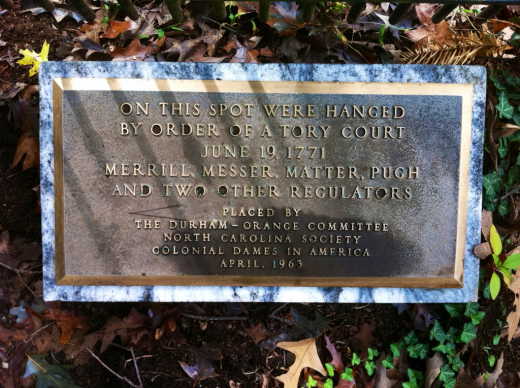
On June 19, 1771, he was hung in Hillsborough, North Carolina. There is a plaque there commemorating his heroism.
This took place before the start of the Revolutionary War, but was a precursor to that war. You can Google Benjamin Merrill for more information.
JEMIMA SMITH, b 1729 Hopewell, Mercer, NJ, d Feb 1803 Rowan, NC.
“After (Benjamin’s) execution his widow (Jemima) remained on the old homestead, a valuable and well-cultivated farm. Miss S. Turner … told Rev. H. Sheets that she recalled hearing her aunt, Mary Workman, tell of calling in to visit the widow while on her way to meeting at Jersey Church. Her aunt told her that the widow was blind. Whether the blindness was caused by some natural effect or from excessive grief at the sad and untimely death of her husband was not known.“It is said that she never recovered from the shock and that she suffered great mental distress and spent much of her time in walking to pass off the
melancholia which clung to her and darkened her days with grief and bitterness. Regardless of all this we know that she returned to the old homestead and lived there with her children for several years. During this time she remained faithful to her church and on one particular occasion in Nov 1771, she and the children attended Soelle’s services in the River Settlement. Soelle said, `She cannot forget the fate of her husband.’“In 1775, Jemima married Harmon Butner who came to live with her and the Merrill children on the Merrill plantation. … Jemima Merrill Butner lived about 30 years after the death of Capt Merrill.”

Benjamin and Jemima Merrill
7th gg
8th gg
9th gg
 Duke City Roots