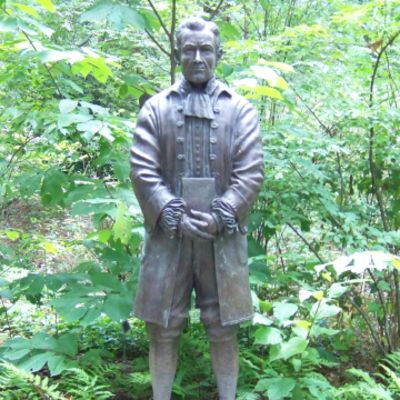
Hezekiah Alexander was one of eleven children of James Robert (The Yeoman) Alexander and Margaret McKnitt. He was married to Mary Ann Sample (1734-1805) and they had eleven children. He was the 5th great uncle of Reba’s father, Frank Newland.
He was born in Cecil County, Maryland, (at the very top and east of Maryland) where his grandfather had emigrated from Ulster, Ireland. He later moved to Mecklenburg, North Carolina, four miles east of where the city of Charlotte was founded. Their house was built in 1764 and is still standing.
On May 20, 1775 he was one of the signers of the Mecklenburg Declaration of Independence, which declares independence from England and predates the 1776 Declaration of Independence. There is some controversy about this document as it was not published until 1819, because it was apparently destroyed in a fire and recreated by John McKnitt Alexander (Hezekiah’s brother) and published. Many scholars no longer consider it authentic. Thomas Jefferson was adamant that it was not, as some of its phrasing echoed his own writing in the Declaration of Independence. John Adams initially supported its authenticity as he bore some resentment towards Jefferson for all the credit he received from authoring the Declaration, and ribbed him in a letter, implying that he may have borrowed some of the Mecklenburg turns of phrases. This incensed Jefferson and his strongly worded response convinced John Adams that the Mecklenburg Declaration was not authentic. This document had been a source of pride for North Carolina and they were in an uproar over this disrespect as they saw it.
Though the Declaration may not be authentic, the Mecklenburg Resolves are real. Written on May 31, 1775, they are not a declaration of independence but rather a set of resolves rejecting the laws of Parliament. Some feel that the controversy over the Declarations is pointless, as the Resolves themselves are quite a bold statement of the desire for independence.
A sad counterpoint to the desire for freedom and independence is the fact that Hezekiah and other men of the time denied freedom and independence to the people that they enslaved.
When speaking of the validity of the Declaration, historian Dan L. Morrill said, “Ultimately, it is a matter of faith, not proof. You believe it or you don’t believe it.” North Carolina chooses to believe it, as the state symbol and flag both continue to bear the date May 20, 1775 – the creation of their state’s alleged contribution to the movement toward American independence.
Here is an opposing opinion from William Henry Hoyt: Historians have generally concluded, however, that the document as it is now known is at best a later reconstruction drawing heavily on the language of the 4 July 1776 Declaration of Independence (PTJ, 1:429–33). A meeting in Mecklenburg County had indeed passed resolves suspending British rule on 31 May 1775, and the text above was composed by an unknown author basing his work on brief notes on those resolves written from memory in 1800 by John McKnitt Alexander.
The passage of twenty-five years likely explains the metamorphosis from what were probably more reserved resolutions into a so-called “declaration of independence” (William Henry Hoyt, The Mecklenburg Declaration of Independence: A Study of Evidence Showing that the Alleged Early Declaration of Independence by Mecklenburg County, North Carolina, on May 20th, 1775, is Spurious [1907]).
Here is an excerpt from J.B. Alexander’s book, “Reminiscences of the last sixty years ” about Hezekiah:
“I do not suppose of all the signers of the (Mecklenburg) Declaration of Independence, there was one superior in ability, or was more determined in severing the relations with the mother country than Hezekiah Alexander. He considered well the the course they were about to take; if the Colonies should not fall into the same line of thought with Mecklenburg country, their doom was sealed, and each one of them would pay for the crime of treason.”
History records the name of Hezekiah Alexander as an administrator and councilor. He held the post as Magistrate from the first appointed one in the county and historians have said “He was one of the most clear headed Magistrates in the County before the Revolutionary War and following the Declaration of Independence was named one of the members of the State Councul [sic] of Safety. In the Revolutionary War he was the paymaster for the 4th Regiment of North Carollina Troops, then became 1st lieutenant in 1777, and retired June 1st, 1778.
Mini biographies of Scots and Scots Descendants
Here is an excerpt from “The History of Mecklenburg County, by J.B. Alexander:
(Hezekiah’s) old house has a great cavern of a cellar where tradition says Mrs. Hezekiah Alexander used to store the rich products of the farm, many jars of honey being part of their contents. Just in front of the cellar door is, or used to be, a large flat stone; and upon this stone the British soldiers broke all the jars of honey which they could not carry away with them. They would not leave anything for the old rebel and his family. There is a beautiful spring near the house with a stone arch built over it, a stone spring house for dairy purposes, whose size indicates that milk, butter and cheese must have been so abundant as to require considerable room.
One of the unusual proofs of Hezekiah’s love of religious freedom was a carving of a fish on his house, the secret symbol, which Presbyterians used in Scotland and Ireland to signify allegiance to the Presbyterian faith.
… Tradition states that the two daughters of Hezekiah Alexander were very beautiful women. Mrs. Captain Cook, who was deputed by the town to entertain Gen. Washington when he was the town’s guest in 1791, was considered a good judge of female beauty, having seen much of the world and she said she had never seen any beauties who equaled these two Misses Alexander. One of them married Charley Polk and met a very tragic fate. Her husband was cleaning his gun in her room (where she was sitting with her child in her arms), when it went off and killed her. He subsequently announced his intention of marrying his beautiful sister-in-law but her brothers objected very decidedly, and his own brothers also interfered to prevent the marriage, and he had to give it up.
It was necessary at times for Mary Alexander to hide her sons in the weeds to prevent them from being kidnapped by the British soldiers and used as hostages.
From the day when maurading [sic] Indians, killed the settlers; to the day when Tory neighbors informed the enemy where supplies could be obtained by foraging; to the days when the British Soldiers burned homes and confiscated personal belongings, Hezekiah Alexander remained calm and led the people of his community toward a just peace.


 Duke City Roots