John McKnitt Alexander was the younger brother of Hezekiah (from the last post), and was the last child of James Robert (The Yeoman) Alexander and Margaret McKnitt. He was named after Margaret’s brother, a lawyer.
He married Jane Bain (also spelled Bane or Bean) and they had five children. He had moved from Cecil County, Maryland (or sometimes stated Pennsylvania since it is very close) with his brother Hezekiah and sister Jemima in 1754.
“His name is so conspicuous in the history of his country, that it is necessary to speak more at length of him and his family than many others of equal virtue, but who did not appear at the front so prominently in the stirring times of the last quarter of the Eighteenth Century. John McKnitt Alexander was born and reared in Pennsylvania, dating his birth in 1733, he was 21 years old when he came to Mecklenburg in 1754. He had learned the tailor’s trade while a minor, and followed this avocation for a number of years, taking cattle and hides in exchange for work, which he would carry to Philadelphia to find a market. There he would purchase broadcloth and other fine material to make into suits for the more wealthy class of his customers. He was also a surveyor, and it is more than probable that he surveyed the greater part of all the lands of the early settlers.
During one of his trips to Pennsylvania, in 1759, he married Jane Bain. He had built a home on what was afterwards known as the Statesville road, nine miles northwest of Charlotte. His house was the general rendezvous for the intelligent and patriotic for many miles in all directions. It was here the patriots were accustomed to meet and consider the condition of the country for months before the political climax was reached.
After much deliberate thought these patriotic pioneers agreed to meet in Charlotte as the most central point and give expression to their deliberations, where, on the 20th of May, 1775, the just celebrated Declaration of Independence was promulgated amid the shouts and huzzas of a populace fully prepared to indorse it with their lives, their fortunes and their sacred honor. Mr. Alexander being the Secretary of the Convention, was the custodian of all the documents and papers, including the ever memorable original draft of the Mecklenburg declaration, which was destroyed by the burning of his house in the year 1800.
Biographical sketches of the early settlers of the Hopewell Section…J.B. Alexander
(Many of his original minutes from the Convention also burned, making it more difficult to assess the authenticity of the Declarations)
An article from the Charlotte Observer dated May 20, 1775 says:
‘The secretary of the militia meeting has been John McKnitt Alexander, whose beautiful plantation home “Alexandriana” has been the scene of many a political meeting on the state of the colonies and the county these past few years.
“J. McKnitt” as he often styles himself is one of the most influential citizens of Mecklenburg. Six feet tall with high forehead and flashing black eyes – he addresses every gathering in a calm and deliberate but exceedingly earnest and emphatic manner”…. Alexander began earning his living as a tailor, but has been active, increasingly, in land sales and in surveying. He is one of the largest land owners in the county and is an elder in Hopewell Presbyterian Church.”
Of the possible 28 signers of the Mecklenburg Declarations, six were members of the Alexander family: John Mcknitt, Hezekiah, Adam, Abraham, Charles and Ezra. Here is a story about another of the signers:
Duncan Ochiltree was one of the original signers of the Meckenburg Declaration of Independence. Although Duncan Ochiltree was credited as being one of the original signers, his name was removed from all subsequent accounts of documents because he became a traitor by becoming a Quartermaster for the British. He owned a mercantile store as well as land, but he knew his fellow citizens would punish him for his change of heart and political leanings. According to Alexander, he begged John McKnitt Alexander to spare his life and protect him, after the British Army left the Charlotte area. John promised him protection while he was in his own home, but he advised him to leave the area immediately. Ochiltree reportedly fled to Wilmington and later moved to Florida. John McKnitt Alexander told his slaves, Cato and Ruth, to burn the stockyard and barn rather than give food and provisions to Ochiltree for the British. When this event he feared happened, Cato and Ruth did burn the building and year’s worth of farm work to ashes.
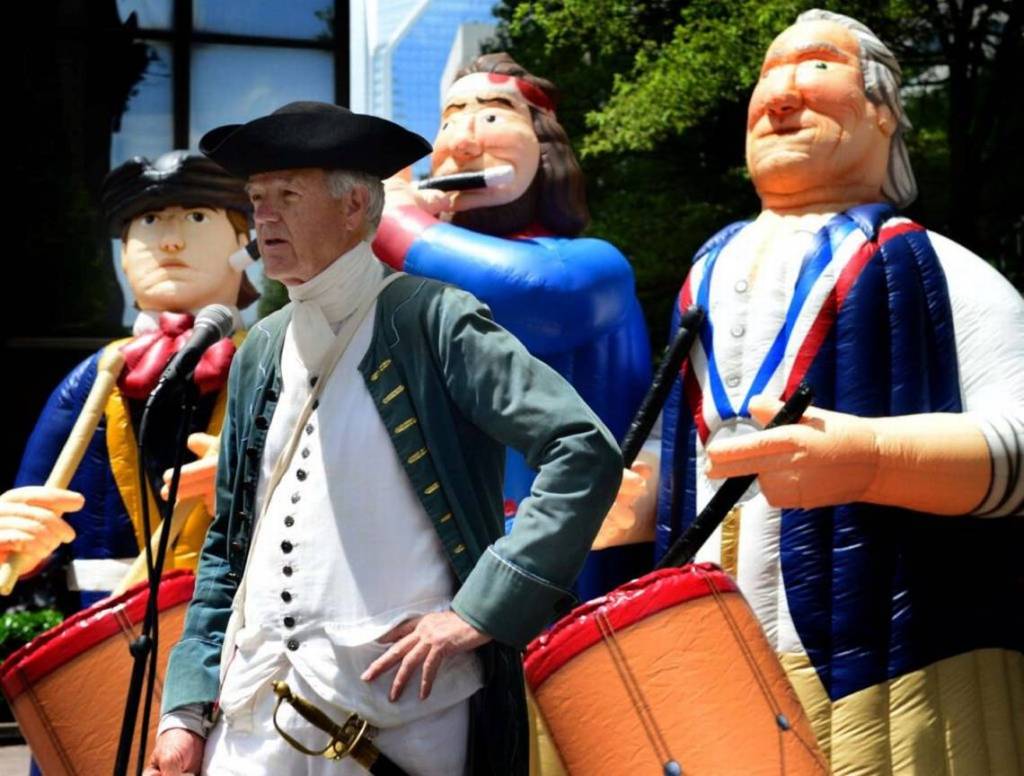
MeckDec Day (May 20) is still marked in North Carolina.
How to celebrate MeckDec Day — the best holiday in Charlotte — this weekend
Charlotte Observer 10/19/2016 (update)
An interesting aside to the story of the Alexanders in Mecklenburg County lies with their tangential association with the Regulators – the story of which was detailed in Benjamin Merrill’s post.
Here is an excerpt from: History of Mecklenburg County and the City of Charlottte, from 1740-1903 by D.A. Tomkins, 1903
“A number of Mecklenburg men were in the ranks of the Regulators, but as they had no organization among themselves, it is not possible to estimate their number. Mecklenburg people recognized the justice of the cause for which the Regulators shed their blood, but they did not deem it prudent to make open resistance to authority at that time. The Phifers, Alexanders, Polks and other prominent citizens were not the kind of men who strike without carefully considering the consequences, but from May 17, 1771, independence of thought steadily developed into independence of action. The young men were not so conservative as their fathers, and they did not hesitate to express sympathy for the men who were struggling against oppression. Col. Moses Alexander was commissary for General Waddell, and while his wagons, laden with powder, were passing through the county, they were captured and the powder was destroyed by nine boys who have since been known as “The Black Boys of Mecklenburg.” They blacked their faces and disguised themselves as Indians before attacking the wagons, and from this they gained their name. These boys were afterwards noble soldiers in the Revolution.”
This interpretation makes it seem as though the Alexanders and other prominent citizens of Mecklenburg County realized that the Regulators were fighting a just cause against the British and General Tryon, but at the same time wanted to stay somewhat out of it as the harsh regulations and taxes hadn’t hit them yet as Mecklenburg was a newer county. It is interesting to note that Moses Alexander (the son of John McKnitt Alexander) was commissary for General Waddell, the British general who was sidetracked by Benjamin Merrill earlier.
 Duke City Roots