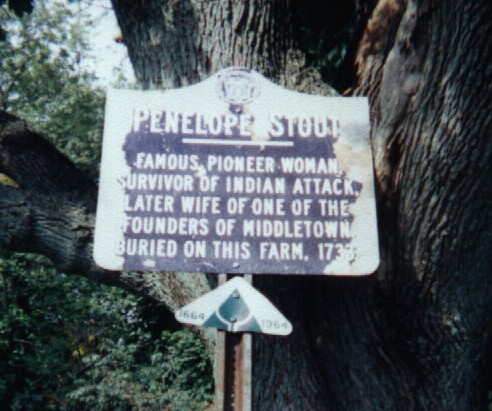
The story of Penelope Von Princis Stout is an amazing tale. The story begins when she and her husband came to America around 1643 from Holland (or possibly England). The ship wrecked on the shores near Sandy Hook in what is now New Jersey, and the passengers fled to New Amsterdam (now New York City) for safety, leaving Penelope and her sick husband behind. The Indians killed the husband and gravely wounded Penelope who hid in a hollow tree for a few days, and was rescued by two Indians – a younger one who wanted to kill her and an older one who wanted to save her. The older man nursed her back to health and she was traded to the settlers.
Later the older Indian saved her again by warning her of an imminent attack on the settlement.
This account has undergone many variations and no doubt has been embellished over the years. The truth of what happened is unknown – was it as stated or was there just a germ of truth in it? No one can say for sure. The article in Wikipedia is somewhat skeptical of many of the unsupported assertions. You can find lots of information about her on the internet.
She married Richard Stout in perhaps 1644, and had 10 children. He came from England and had apparently been a sailor for seven years before settling on Long Island. They first settled in Gravesend, Long Island, but later helped found the town of Middletown, New Jersey. Some accounts have her living to the age of 110, but this is unlikely. They were the great grandparents of Benjamin Merrill.
Samuel , John, Andrew, William, Nancy, Penelope, Charles, Elijah, Jonathan, Ellen.
The people of the Jersey Settlement were strongly anti-British, and the Merrill family especially so after their father was killed. Many of the sons served in the Revolutionary War.
Samuel (1748-1818) was a child when his parents moved to North Carolina from New Jersey. After his mother’s death in 1802 he inherited the plantation and continued to work on it. He was also known as a master weaver. He served in the Revolutionary War and also provided provisions to the army. He was married to Susannah York and they had six children. His son Azariah’s daughter is Elizabeth Merrill Winkler.
John (1750-1838) was a blacksmith and farmer and was a lieutenant in the Revolutionary War. He served as drummer in 1776 and was a lieutenant under several different commanders through 1781. He married Mary Catherine Wiseman and they had nine children, and eventually moved to Mississippi.
Andrew Merrill (1752-1826) also apparently served in the war. He married Rachel Wiseman. They had three children and eventually moved to Tennessee.
William (1753-1803) also was apparently a drummer in the Revolutionary War. He married Sarah Haden, they had six children and eventually moved to Alabama.
Penelope (1760-1830) married Benjamin Merrill Jr., her first cousin. He was the son of her father Benjamin Merrill’s brother William. Benjamin served throughout the Revolutionary War. They had fifteen children and moved to Cane Creek, North Carolina.
Nancy (1760-1828) married Boyd McCreary and they had nine children. She eventually moved to Missouri.
Charles Merrill (1761-1822) served in the Salisbury District Brigade during the war, even though he must have been a teenager. After his father’s death, he was “bound” to his brother John to learn blacksmithing skills. He married Elizabeth Easley, they had seven children and wound up in South Carolina.
Elijah Merrill (1763-1807) was “bound” to his older brother Samuel to learn the weaver’s trade after their father’s death. Samuel was to give him a loom and a tackle. He also served in the army. The name of his wife is not known, he had one child and stayed in his hometown.
Jonathan Merrill (1765-1849) was “bound” to his brother-in-law Boyd McCreary after his father’s death. He married Nancy Elliott and had fourteen children, and moved to Tennessee.
Ellen Merrill (1770-1822) apparently didn’t marry.
Benjamin Merrill (1731-1771) and Jemima Smith Merrill (1728-1801) were born in Hopewell, New Jersey and married there about 1747. They then moved to the Jersey Settlement in Rowan County, North Carolina in about 1749-50. They had ten children. Benjamin had a large farm south of Lexington, and worked also as a gunsmith.
The British had imposed a harsh system of taxation on the farmers of the area, and seized property and land when the people couldn’t pay – the farmers didn’t have much cash, but relied on bartering for many of their necessities so it was a real hardship and tensions were building up. There was a lot of resentment toward the Royal governor, William Tyron and the sheriffs and judges that were corrupt and enriching themselves at the expense of the ordinary people.
The farmers formed a kind of militia known as the Regulators to try to stand up to the British. At first they tried to negotiate with them, but later got more vociferous and physical, and got into some skirmishes. They were willing to be British subjects, but were tired of being trampled on and exploited.
Governor Tryon intended to make a show of force, and gathered around 1000 men on May 16, 1771 near the Alamance Creek to threaten the Regulators. The Regulators gathered there as well in hopes of getting Governor Tryon to agree to a more fair and equable system, but he scoffed at their demands and shot and killed one of the Regulators as he started to head back after negotiating. Tryon ordered the Regulators to disperse, they refused and he then ordered his men to fire on them. This is known as the Battle of Alamance. The Regulators were poorly organized and outgunned and were defeated.
Capt. Benjamin Merrill was riding there with a group of 300 men. He hadn’t gotten there yet, but intercepted Captain Waddell and a group of men heading to General Tryon’s aid and turned them back, taking several prisoners.
He was captured, dragged through the town in chains and imprisoned. He was sentenced to a gruesome death.
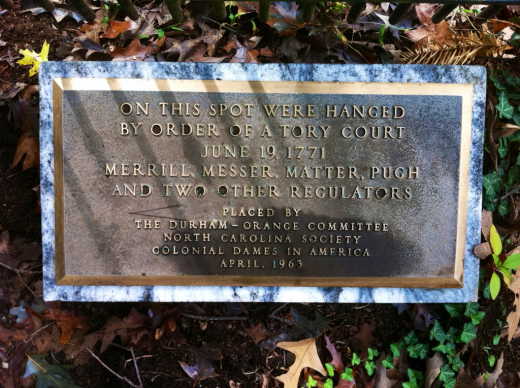
On June 19, 1771, he was hung in Hillsborough, North Carolina. There is a plaque there commemorating his heroism.
This took place before the start of the Revolutionary War, but was a precursor to that war. You can Google Benjamin Merrill for more information.
JEMIMA SMITH, b 1729 Hopewell, Mercer, NJ, d Feb 1803 Rowan, NC.
“After (Benjamin’s) execution his widow (Jemima) remained on the old homestead, a valuable and well-cultivated farm. Miss S. Turner … told Rev. H. Sheets that she recalled hearing her aunt, Mary Workman, tell of calling in to visit the widow while on her way to meeting at Jersey Church. Her aunt told her that the widow was blind. Whether the blindness was caused by some natural effect or from excessive grief at the sad and untimely death of her husband was not known.
“It is said that she never recovered from the shock and that she suffered great mental distress and spent much of her time in walking to pass off the melancholia which clung to her and darkened her days with grief and bitterness. Regardless of all this we know that she returned to the old homestead and lived there with her children for several years. During this time she remained faithful to her church and on one particular occasion in Nov 1771, she and the children attended Soelle’s services in the River Settlement. Soelle said, `She cannot forget the fate of her husband.’
“In 1775, Jemima married Harmon Butner who came to live with her and the Merrill children on the Merrill plantation. … Jemima Merrill Butner lived about 30 years after the death of Capt Merrill.”
Godfrey Winkler married Elizabeth Merrill (1799-1857) in 1816, in Rowan North Carolina, and had one daughter, Sarah (1822-1900). We have no pictures of Godfrey or Elizabeth.
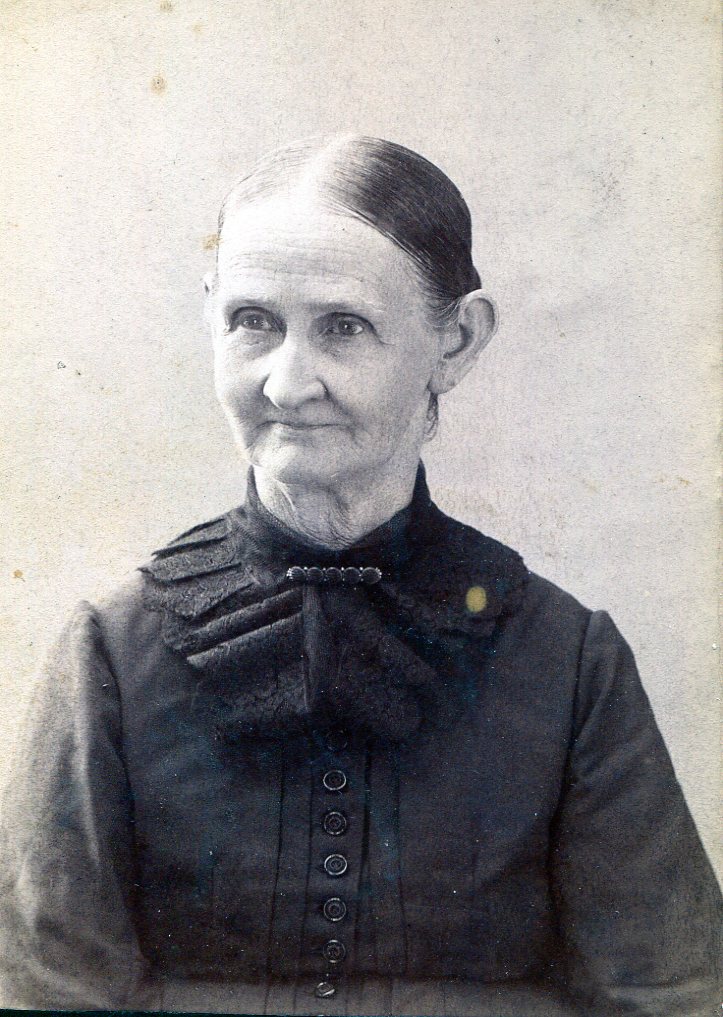
Sarah Winkler Frank 1822-1900
Then he married Leah Huddleston in 1823 in Madison, Indiana, and had ten additional children.
This wasn’t unusual, as often there is a second marriage after the death of the first spouse. But, Elizabeth didn’t die until 1857.
I believe divorce was unusual in those days – I’ve hardly ever seen a record of it back then. And there doesn’t appear to be one for Godfrey and Elizabeth. So that leaves us with the question of what happened?
There’s really no information to be had – just one line I saw in a family history done by Mabel Roper or Blanche Bratcher (Our grandmother and great aunt). When they came to Godfrey Winkler, their great-grandfather, they wrote “disappeared around 1823.” I guess that’s all they knew of him, not knowing he was still around and remarried with all those kids. There was no Ancestry back then to provide these details.
William and Sarah had nine children: Barbara, Noah, Isaac, Edward, Martha, Mary, Columbus, Sarah and Charles.
Only Barbara, Edward, Martha and Sarah lived past their twenties.
Isaac (1845-1863) drowned in a river the year after Noah died. We don’t have much information about him other than a letter to him written by a friend shortly before he died.
An entry from Minnie Lee’s journal about her uncle Isaac
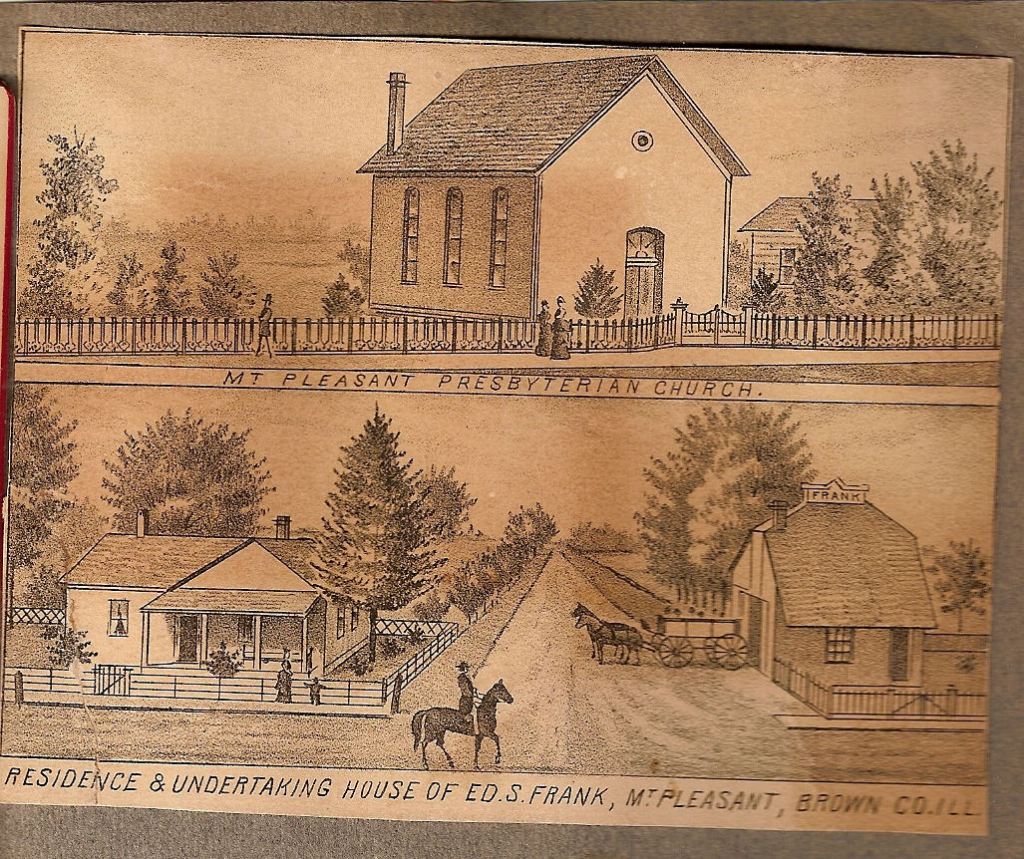
Edward (1848-1902) married Martha Moorehead and had two children, Nonae and James. His obituary says “his early life was spent on the farm, and when he grew to manhood he followed blacksmithing, and then engaged in the undertaking business in Fargo. He was named after Edward Smith, a great opposer of slavery.
Edward Frank, above, and view of his residence and undertaking business belowMartha (Mattie) Frank 1853-1933
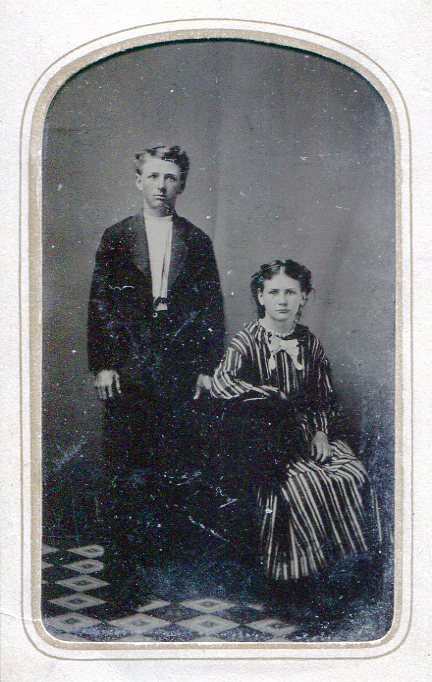
We don’t have any information on Martha (1853-1933) other than this picture. Likewise with Mary (1850-1874), Columbus (1855-1878) although we do have his picture with Sarah, or Charles (1861-1862).
Sarah was the next-to-last child of William and Sarah Winkler Frank and was three when Noah died. She had an interesting life! She was a school teacher, and also started a business school in Carthage, MO. When she was in her sixties she went on an ocean liner to do missionary work in Hawaii. It was in 1921 when Queen Liliuokalani was on the throne.
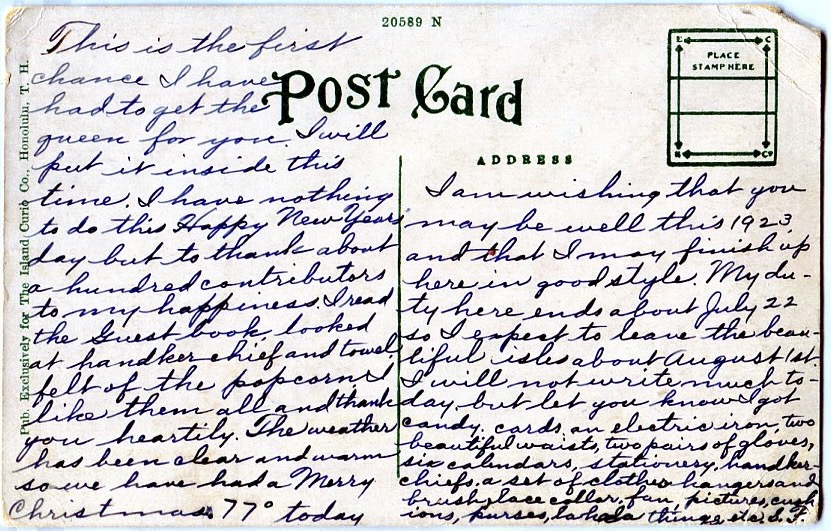
We have several postcards and letters from her – she was quite a traveler. In one postcard she says she hopes it’s not too cold for her camping trip in Colorado – on that trip she visited her niece Minnie Lee and her family (including Mamie) at their home near La Junta, Colorado. Minnie’s husband, Henry was a telegraph operator for the railroad and they lived close by.
Sarah and her big brother, Columbus One of Sarah’s postcards from HawaiiSarah Frank and her friend Ethel Cupp visiting the Lee family – Grace, Sarah, Ethel, Blanche, Mabel (Mamie), Minnie, Henry, Harlan
William (1819-1912) and Sarah Winkler Frank (1822-1900) were Barbara Lucas’ parents. They were born in Davidson Co., North Carolina and moved to Timewell IL (previously called Mound Station), and had nine children.
This newspaper article was written in the 1960s and mentions William Frank.
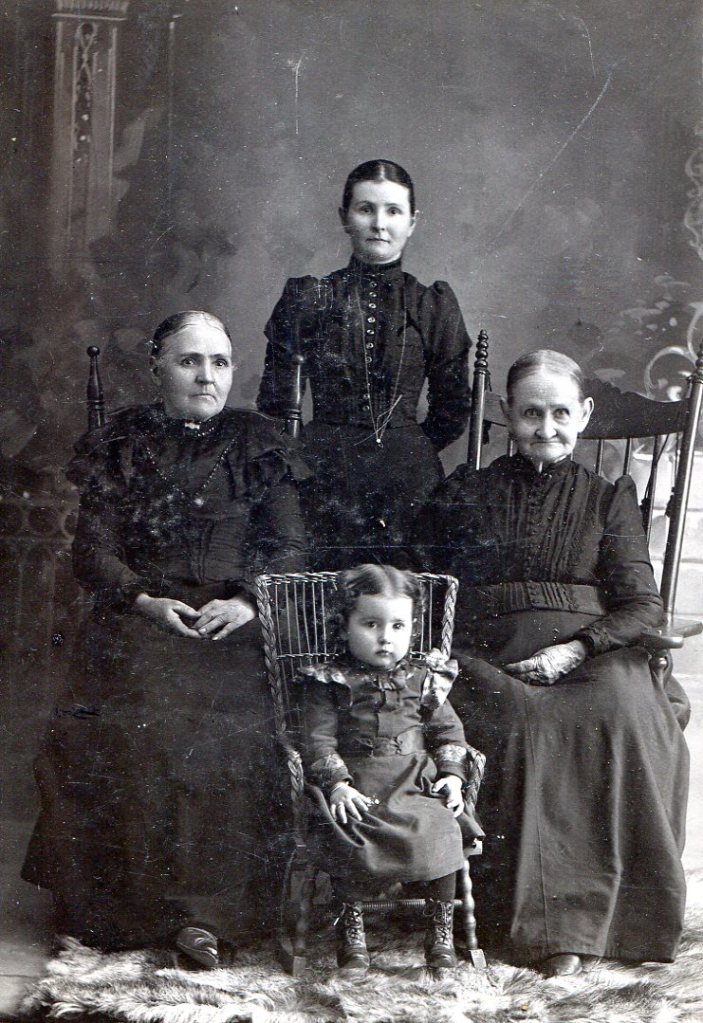
Willam Frank (in the bottom picture he has a cane like the article mentions)Barbara Lucas, Minnie and Mabel Lee, Sarah Winkler Frank










 Duke City Roots