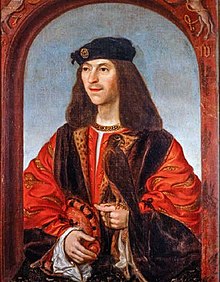
James (March 17, 1473-September 9, 1513) became the king of Scotland on June 11, 1488, at the age of fifteen, when his father, James III, was killed at the battle of Sauchieburn. He felt guilt about his father’s death for his whole life, as he had led a band of rebels against his father which led to the battle. He feared that it was his fault even though he had given orders that his father was not to be harmed. For the rest of his life he wore a heavy iron belt around his waist as penance (he was also called James Iron Belt Stewart). His father had not been a popular king, and had lost the backing of the Scottish nobility, and had been suspicious of his son, all factors which led up to the rebellion.
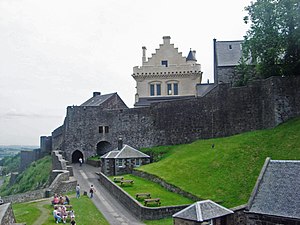
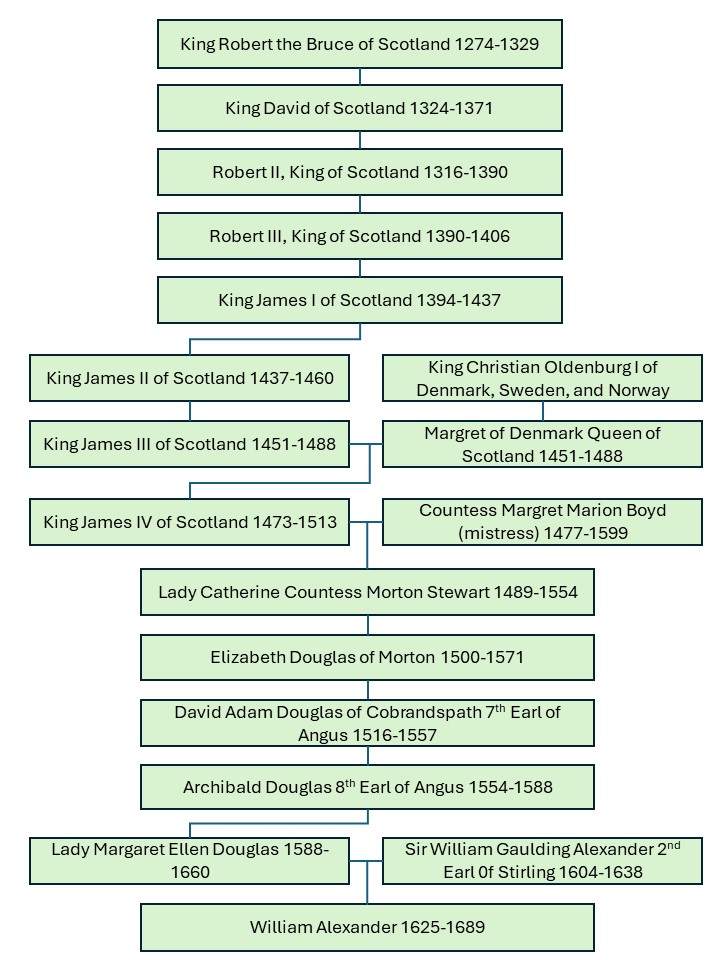
He was born at Stirling Castle, the eldest son of James III and Margaret of Denmark. Margaret’s father was King Christian Oldenburg I of Sweden, Denmark and Norway. He was well educated and fluent in several languages and also was the last monarch to be fluent in Gaelic.
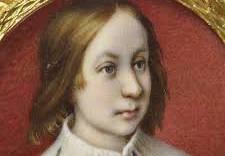
Young James
Stirling Castle
He was a popular king, and thought to be the most effective of the Stewart (or Stuart) kings. Erasmus said of him :´He had wonderful powers of mind, an astonishing knowledge of everything, an unconquerable magnanimity and the most abundant generosity.´ He was known as the first true Renaissance king of Scotland.
He was instrumental in developing Scotland’s navy, and shipbuilding became a big undertaking during his reign. He also responsible for the introduction of the printing press there in 1507. His many interests also included alchemy, dentistry, and other scientific pursuits. Literature and the arts also flourished under his reign. Hunting, jousting, and falconry were also pursuits of his.
“The first evidence of whisky production in Scotland comes from an entry in the Exchequer Rolls for 1494 where malt is sent “To Friar John Cor, by order of the king, to make aquavitae”, enough to make about 500 bottles. James IV reportedly had a great liking for whisky, and in 1506 the town of Dundee purchased a large amount of whisky from the Guild of Barber-Surgeons, which held the monopoly on production at the time.[“
Wikipedia
He was able to get the nobility under control, brought peace among the clans, and ushered in a period of relative internal peace. There were clashes with England though, and in an effort to forge a stronger alliance, he was betrothed to Margaret Tudor, the daughter of King Henry VII, and sister of King Henry VIII. He only had one child who from this marriage who lived to adulthood, and he became James V, (who became the father of Mary, Queen of Scots)
He had several other children, though, with his mistresses. He recognized them and tried to ensure these children had a good life. Catherine, his daughter with Marion Boyd, was married to James Douglas, Earl of Morton. Alexander, his son with Marion, was given a good education and made archbishop at the age of eleven (apparently to keep control over the funds brought into the church)
He made an alliance with France in 1512. When England invaded France he unwisely decided to invade England, against the advice of his councillors. His troops were armed with pikes, and they had some heavy artillery, and the English were armed with light artillery, billhooks, and longbows. The Scots had the advantage in numbers (approximately 34,000 troops) and weapons, but they found themselves in a bad position, as they encountered a marshy, soggy area on their way forward and lost momentum, and they were disastrously defeated in what is known as the Battle of Flodden. Both he and his son, Alexander (the archbishop) were killed. He was a courageous soldier, leading his men into battle, but a rash and impetuous general. Around fifteen thousand Scots lost their lives in three hours, a death toll unmatched until WWI. They lost a major part of their nobility and leadership, which caused years of unrest and instability.
The battlefield today. The British army marched down the grassy field, and the Scottish army down the plowed field. The dividing line between is the marshy area.
James IV and Marion Boyd 16th, 17th, 18th grandparents
Catherine (illegitimate daughter of James IV) 15th, 16th, 17th great grandmother
King Christian I of Oldenburg 18th, 19th, 20th great grandfather
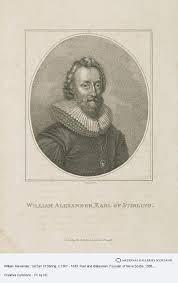
Royal Courtier, Scholar, Colonizer, Poet and Statesman
William Alexander (1567-September 12, 1640) was born in the manor house of Menstrie, Clackmannashire in Scotland.
His father (Alexander Alexander) died when he was young, and he was tutored by his great uncle, James Alexander, and educated at the Universities of Glasgow and Leiden . He was later chosen to be tutor to Archibald, 7th Earl of Argylle and accompanied him to France, Italy and Spain. On his return from these travels he was introduced to the court by the young Earl of Argylle.
In 1603, when the crowns of England and Scotland were united, he joined the court of James VI of Scotland when he assumed the throne as James I of England in London, succeeding Queen Elizabeth. There he became tutor to Prince Henry. “His gifts as a poet, his culture as a scholar, and his high intellectual endowments, strongly commended him to King James…over whose unstable and vacillating mind the able courtier exercised a unique and life-long ascendancy.” (The Clan Donald, v. 2. ch. 3. p. 63) He may have met with some disfavor in Scotland due to his ties to the English throne.
Shortly after his travels, he married the aristocratic Janet Erskine in 1601, and they had seven sons and three daughters.
He became known as a poet and assisted King James in “The Psalms of King David, translated by King James”, which may not have been favorably received, especially by the Presbyterian clergy for its secular language. He wrote his longest work “Dooms-day or the Great Day of the Lord’s Judgment,” a biblical epic from the Creation to the book of Revelations, and was known for his sonnets and tragedies. He was knighted in 1609. Prince Henry died at the age of eighteen in 1612, and Sir William’s poem on his life tragically cut short was appreciated by King James who then appointed him as tutor to Prince Charles.
The King appointed him as “The Master of Requests” in 1614- a post that commissioned him to “discharge all manner of persons from resorting out of Scotland to this our kingdome, unlease it be gentlemen of good character…” (Dictionary of National Biography. v. 1-22. p. 278) Apparently it was meant to ward off the onslaught of requests from needy Scots.
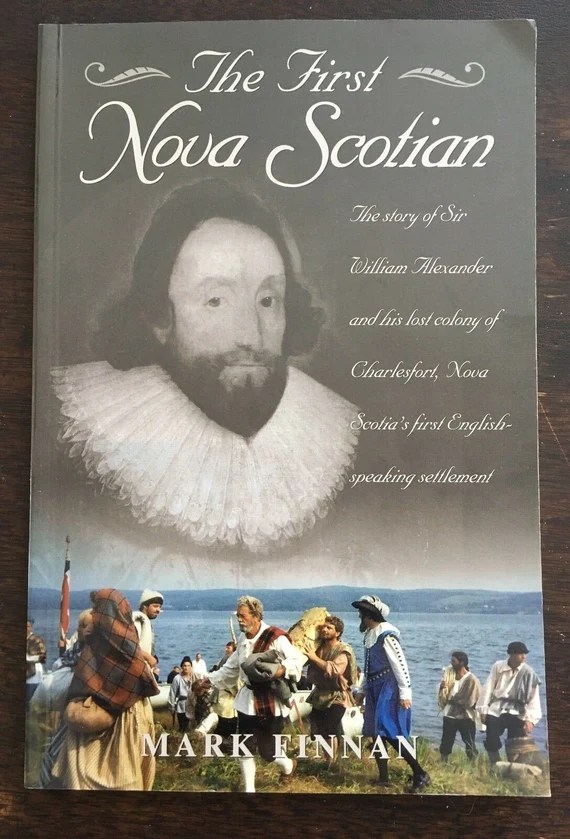
In 1621 he received the highest honor of his career – the grant of Nova Scotia, and practically all of Canada. The king wanted to populate these provinces with loyal British subjects as they had done with Ulster, and so created a plan in which Sir William would divide the land into parcels and sell them with a baronet title attached. Unfortunately some of the land in this grant was already claimed and occupied by France.
The charter was enlarged after King Charles came to the throne and gave William the authority to “erect cities, appoint fairs, hold court, grant lands and coin money.” (Dictionary of National Biography, v. 1-22. p. 279) He was almost a king himself to this new world. His efforts at colonization though were not very successful. “William showed high-hearted courage in his efforts to colonise but the difficulties were enourmous, and the opponents (including France) formidable, but the good knight never knew when he was beaten, He and his son made effort after effort. ” (Dictionary of National Biography. v 1-22, p. 279)
He may be that his nature did not excel in practical matters – he seemed to be more of an idealist and dreamer, with an “impulsive Celtic spirit and visionary poetic nature who saw things through a golden halo, in which difficulties vanished and triumph was assured.” (The Clan Donald, v. 2. ch. 3, The Earls of Stirling p. 67)
Eventually the French prevailed and Sir William lost much of the land – he was promised recompense for his losses, but never received payment. He was never able to get many colonists to settle there either. The difficulties of the long voyage, lack of communication, lack of infrastructure, and involvement of France made the chances for success low.
in 1626 he was appointed secretary of state for Scotland, which he held to his death. “With consummate ability, and single-eyed patriotism and long patience he ruled Scotland for the king. …he had a cool head, a sound judgment , a generous heart and a firm hand.” (The Clan Donald, v. 2, ch. 3. The Earls of Stirling)
In 1626 he bought and remodeled his house in Stirling, known as Argyll House, and when Charles I ascended to the throne in was given the title Earl of Stirling, with the additional title Viscount of Canada.
He died in 1640 in London, plagued with debt, his Nova Scotia project a failure. The town of Stirling reclaimed his house, in lieu of his unpaid debts. The title of Earl lapsed in 1739 on the death of the fifth earl.
Ebenezer Folsom (1743-1814) was born in Rowan County, North Carolina. He was the 3rd great grandfather of Reba (Granny), on her father’s side.
Ebenezer first married a Choctaw woman, Ni Ti Ka Tehani in 1780, and they had two daughters, Rhoda and Sophia. Ni Ki Ta may have died after giving birth to Sophia, and it seems that Ebenezer placed Sophia in the care of his brother Nathaniel and married Sarah Paul and then moved to Arkansas and married Mary Leard. He and Sarah had one child, Miguel, and he and Mary had at least one child, Ebenezer B. Folsom who had a daughter, Jane, who was Reba’s great grandmother.
Ebenezer Folsom
His son wrote of his father “My father was a man of fine personal appearance; he was very energetic and enterprising and a man of extraordinary judgement. He emigrated from Louisiana to Texas A. D. 1838, the same year I was born.”
Ebenezer had gone to Mississippi with his family when young – his brother Nathaniel said that “their father (Israel) wanted to go there to get money – they say it grows on bushes there.” Ebenezer lived in the Choctaw and Chickasaw nations with his family, and then later ran away and moved in with Nathaniel who had earlier run away himself and moved there, and that is when he married Ni Ki Ta. Nathaniel married two Choctaw sisters and had twenty four children.
Ebenezer and Ni Ki Ta’s daughter Sophia also known as Li Lo Ha Wah (1773-1871) married Major John Pitchlynn (1765-1835) He was born in a boat offshore the island of St. Thomas, where his parents had traveled from England. His father Isaac was an officer in the English army. Isaac died when traveling in Choctaw country and John was raised by the Choctaws.
Sophia Folsom Pitchlynn
The following is from Wikipedia about John Pitchlynn:
In 1830, Congress passed the Indian Removal Act, allowing for the removal of the Choctaws and many other tribes from their native lands and moving them west of the Mississippi River.
Excerpts from “Removing the Heart of the Choctaw People: Indian Removal from a Native Perspective.” Full reference below
In 1830 the Choctaw Nation occupied some of the most fertile lands in North America. In the heart of what would become the Cotton Kingdom, the Choctaws’ lands encompassed most of the Mississippi delta lands of Mississippi, as well as regions of Alabama and Louisiana. According to Choctaw traditions, these lands had been Choctaw lands forever, given to them by the Great Spirit, Chitokaka. The Choctaws resided in villages along rivers and streams, where they followed a primarily agricultural and sedentary lifestyle.
The 1820s saw the rise of Andrew Jackson to national prominence. He was extremely popular in the backwoods areas of the American South, where he consistently called for the expulsion of the resident Native nations.
The Choctaws were confident, because of their traditional expectations of the behavior of allies and friends, that the American government would stem the incursions into their lands, and would guarantee, as promised, their continued sovereignty and territorial integrity. Despite Jackson’s long personal history with the Choctaws, however, he now formed the core of those calling for their dispossession and exile.
Indian Removal, as the whites termed it, created moral and spiritual crises intimately linked to fundamental Choctaw beliefs about place, origin, and identity. Choctaws had a deep spiritual and physical attachment to the earth.
The Choctaws tried to convey the imperative reasons that they remain in the lands of their ancestors to the U.S. agents and government. They could not understand the whites’ assertion that they took the Choctaws’ well-being to heart as they forced them away from that which gave them life. One old man haltingly attempted to impart some understanding of their dilemma to an American agent. He said, “We wish to remain here where we have grown up as the herbs of the woods, and do not wish to be transplanted into another soil.” The Choctaws saw themselves as part of the soil, an integral element of the ecosystem, tied inextricably to this specific part of the earth. Their world was a vast, complex system of life and spirits, all comprising an indivisible whole. Like the old man’s herbs, the Choctaws believed they could not be separated from their mother, the land of which they were a part.
The journey to the West was characterized by American ineptitude, incompetence, and fraud. Many Choctaws died or became seriously ill due to exposure, disease, and inhumane arrangements for their journey. Most of the nation was forced to walk the entire journey, which was more than five hundred miles.
Nearly one-third of the Choctaw Nation died on the march west. Many of these were young children and elderly tribespeople, who disproportionately suffered from exposure, hunger, and disease.
The story of the American policy of Indian Removal must be reexamined and retold. It was not merely an official, dry, legal instrument as it often is portrayed. Removal, as experienced by Native people, was an official U.S. policy of death and destruction that created untold human pain and misery. It was unjust, inhuman, and a product of the worst impulses of Western society. Indian Removal cannot be separated from the human suffering it evoked—from the toll on the human spirit of the Native people.
AMERICAN INDIAN CULTURE AND RESEARCH JOURNAL 23:3 (1999) 63–76 Removing the Heart of the Choctaw People: Indian Removal from a Native Perspective DONNA L. AKERS
In the Library of Congress you can find letters between John Pitchlynn and President Andrew Jackson.
” I beg of you to say to them, that their interest happiness peace & prosperity depends upon their removal beyond the jurisdiction of the laws of the State of Mississippi. These things have been [often times] explained to them fully and I forbear to repeat them; but request that you make known to them that Congress to enable them to remove & comfortably to arrange themselves at their new homes has made liberal appropriations. It was a measure I had much at heart & sought to effect, because I was satisfied that the Indians could not possibly live under the laws of the States. If now they shall refuse to accept the liberal terms offered, they only must be liable for whatever evils & difficulties may arise. I feel conscious of having done my duty to my red children and if any failure of my good intention arises, it will be attributable to their want of duty to themselves, not to me.”
Muriel H. Wright, in “A Chieftain’s Farewell to the American people” American Indian 1, 1926, gives an excerpt from a song sung by the Choctaw people who stayed behind in Mississippi, mourning those who had left.
Hinaushi pisali, Bok Chito onali, yayali.” [I saw a trail to the big river and then I cried.]
Here is an article about Sofia from the 405 Magazine:
The mother of Choctaw Chief Peter Pitchlynn and mother-in-law of Chief Samuel Garland, she was a woman of means who hoped to perpetuate her legacy.
She was born two days after Christmas 1773 to Ebenezer Folsom, a trader and interpreter whose ancestors emigrated from England in the 1630s, and his Choctaw wife.
Her father’s brother, Nathanial Folsom, married two Choctaw sisters – nieces of Miko Puskush, chief of the tribe’s Northeastern District – with whom he fathered 24 children. Each of them was a first cousin to Sophia and, like her, half-Choctaw.
One of the cousins, Rhoda Folsom, married John Pitchlynn. He arrived in the Choctaw Nation in present-day Mississippi with his father at the age of 10, becoming fluent in the language and staying with the tribe after his father’s death. He would go on to work as an interpreter and mediator for the U.S. government for nearly half a century.
Major John Pitchlynn fathered three sons in 10 years of marriage to his first wife. After her death, he wed Sophia Folsom and fathered another three sons, plus five daughters. His influence increased over the years. His holdings grew to include livestock, 50 slaves, 200 acres of corn and cotton under cultivation and part-ownership of a stage line, making him one of the wealthiest men in the Choctaw Nation prior to Removal.
The family’s political strength also expanded. John and Sophia Pitchlynn’s eldest daughter, Mary, would marry Samuel Garland, chief of the Choctaws from 1862-64. Their eldest son, Peter Perkins Pitchlynn, succeeded Garland as chief for a two-year term.
John Pitchlynn signed the Treaty of Dancing Rabbit Creek in 1830. According to the Mississippi Encyclopedia, he and his sons Peter, John Jr., Silas and Thomas received 5,120 acres reserved in the Indian Territory. After liquidating most of their assets in anticipation of Removal, John and Sophia Pitchlynn opted to remain in the Old Choctaw Nation, where he died May 20, 1835.
Sophia migrated west to Indian Territory two years later. A house was built for her next to the two-story home of her daughter and son-in-law, the Garlands, who established a sawmill and cotton plantation.
An Oklahoma story in stone/M.J. Alexander. April 10, 2019
The above article states that Rhoda was Sofia’s cousin, daughter of Nathaniel, but in reality it seems that she was her sister.
One of Sophia and John’s sons, Peter Pitchlynn was also prominent in the Choctaw nation.
“Peter grew up in the traditions of the Choctaw, but desired a formal education as well. He attended school in Tennessee where he had to defend himself against the bullies who teased him for being an Indian. Pitchlynn would stand up for what he believed was right for the rest of his life.
He was home from school when the Choctaw National Council was holding a treaty negotiation regarding their removal from Mississippi. The government negotiator was General Andrew Jackson. Peter believed the treaty was wrong for the Choctaws and created quite a stir by refusing to shake hands with the famous officer.”
“A prominent Choctaw leader during the removal period, Peter Pitchlynn played a major role in building the national tribal government in the nineteenth century.
Pitchlynn thrived as a farmer, stock raiser, slave owner, and member of a small landed elite. Active in tribal affairs, he allied with Moshulatubbe against the missionaries and Greenwood LeFlore. Despite his opposition to the Treaty of Dancing Rabbit Creek, he sold his land holdings, led an emigrant party west in 1831, and settled his family on the Mountain Fork River near Eagletown (in present McCurtain County, Oklahoma) in 1834.
In the postremoval era Pitchlynn emerged as an influential politician and diplomat. He helped reestablish the Choctaw Nation west of the Mississippi and establish a national school system. During frequent missions to Washington, D.C., he pushed Choctaw claims with the federal government and advocated settlement on behalf of Choctaws defrauded of their lands during removal [the Trail of Tears]
After he obtained his degree from the University of Nashville, Pitchlynn returned to his family home in Mississippi, where he became a farmer. The Choctaw were among the Southeast tribes that used enslaved African Americans as workers on their farms. [4]
While Pitchlynn originally owned slaves, he opposed other Choctaw slaveholders like Robert M. Jones and he felt an indifference towards the institution: following the Emancipation Proclamation in 1863, he willingly cast it aside without protest.[8]
Wikipedia
Peter Pitchlynn
Ebenezer and Mary Folsom 4th, 5th, 6th great grandparents.
Sofia Folsom Pitchlynn 5th, 6th, 7th great aunt (half great aunt?)
Peter Pitchylnn 1st cousin 5, 6, 7 times removed (half cousin?)
The Catholic population of northern Ireland had been nearly wiped out In the Wars of the Irish Rebellion during the reigns of Queen Elizabeth I and King James. In the year 1610, King James of England wanted to replace the population of northern Ireland with settlers friendlier to the British and so offered the land to his subjects – many lowland Scots took the opportunity and moved to Ulster. They were successful at farming there for many years but during the reign of Charles I, many started to migrate to America due to his attempts to convert them to Anglicism, as well as the economic prospects looking more promising.
“There is a well established tradition that seven Alexander brothers, Presbyterians from Scotland who had sojourned for a while in the north of Ireland, probably at Raphoe, co. Donegal, and Sligo, co. Sligo came to Cecil County, Maryland before moving on to Somerset. If we may judge from the circumstantial evidence remaining, then along with the brothers came two sisters: one the wife of Matthew Wallace, the other Jane who married John McKnitt.
In Somerset, at early dates, we find William, Andrew, Samuel and John Alexander, and in Cecil County James, Francis, Joseph and Samuel.”
Genealogies of Pennsylvania families from the Pennsylvania Geneological Magazine
Many Alexanders, McKnitts, and Wallaces were included in this migration. The nine Alexanders came to America on the ship Welcome in 1676 and anchored in the Delaware River offshore from the town New Castle.
“In 1676, a Scotch Irish family, with seven brothers and two sisters, by the name of Alexander came from Donegal, Ireland. Some settled in Cecil County others further south in Somerset, Pocomoke and in Virginia. They were farmers, weavers, tanners and blacksmiths. Several Alexanders located just south of Stricklersville Road (now in Fairhill) as they received a 2000 acre land grant in 1717 and 1718. These land grants included the land in Franklin from the Maryland border to Stricklersville Road to Tweeds Mill on the Big Elk Creek. A petition was signed by the Alexander’s in 1722 attesting to the fact that they believed this land was in Maryland.
The Alexander family was a hardy family and had many children. Soon there was not enough land for all of them to continue to live here and through the years the family expanded to Tennessee, North Carolina and up the Susquehanna River to York and other surrounding areas. However, many of our many-generation township residents’ ancestors more than likely were an Alexander. Alexander family members were the founders of both Head of the Christiana Presbyterian Church on Rt. 273 in Delaware and the Rock Church on Rt. 273 in Maryland. Many of them are buried there.”
They intermarried with other Scotch-Irish families, such as the McKnitts and Wallaces.
The details are sketchy on the Alexander family. There is some controversy over the identity of the father. Some think it is the Rev. James Alexander, but most seem to think he had no children, and instead it is William Alexander, who was married to Mary Maxwell.
William (1646-1715) acquired Hunting Quarter (100 acres) in 1687 and Hogg Quarter (100 acres) at the headwaters of Wicomoco Creek. He was married to Ann Liston.
Andrew “The Farmer” 1648-1700 was married to Ann Taylor and had two children Jane and Col. Elias Alexander.
Elizabeth (1650-1692) was married to Matthew Wallace and had seven or possibly more children.
James Benjamin (1652-1740) was married to Mary Steele.
Francis “The Weaver” (1654-1733) was married to Rebecca Smith.
Samuel (1657-1733) Samuel bought lands with his sons Andrew and Francis in 1723 in the southern part of Cecil County called Sligo and Alexandria tracts, and bought a lot for the church at the same time. He was married to Mary Elizabeth Taylor and had nine children.
Mary (1660-1774) was married to John Steele and had one child.
Joseph (1660-1726) “The Tanner” married Abigail McKnitt and was the father of James Robert “The Yeoman” Alexander and several more children.
John (1660-1726) was married to Mary Barbary and had two children.
Joseph Alexander 9th, 10th, 11th great grandfather and 10th, 11th, 12th great uncle
Francis Alexander also 9th, 10th, 11th great grandfater and 10th. 11th. 12th great uncle.
The other siblings are 10th, 11th, and 12th great aunts and uncles.
The other children of James Robert Alexander and Margaret McKnitt, and siblings of Hezekiah and John McKnitt Alexander are:
Theophilus (1714-1768) He was married to Catherine Wallace and had nine children. He served with the Colonial Militia Troops in the Revolutionary War under the command of Captain Thomas Jonson in Cecil County, Maryland, and was a prominent landowner and ruling elder of Rock Presbyterian Church of Lewisville, PA. After his death, his wife and children (with the exception of George, who he left his plantation to), moved to Mecklenburg County, NC. An old stone tavern called the Seven Stars still stands in Cecil County and may have been the site of his home. One of his sons, Joseph was the minister of Bullock’s Creek Presbyterian Church in South Carolina.
Abraham (1720-1778)was also a signer of the Mecklenburg Declaration. He never married.
Keziah (1720-1780) married Walter Sharpe and had one child.
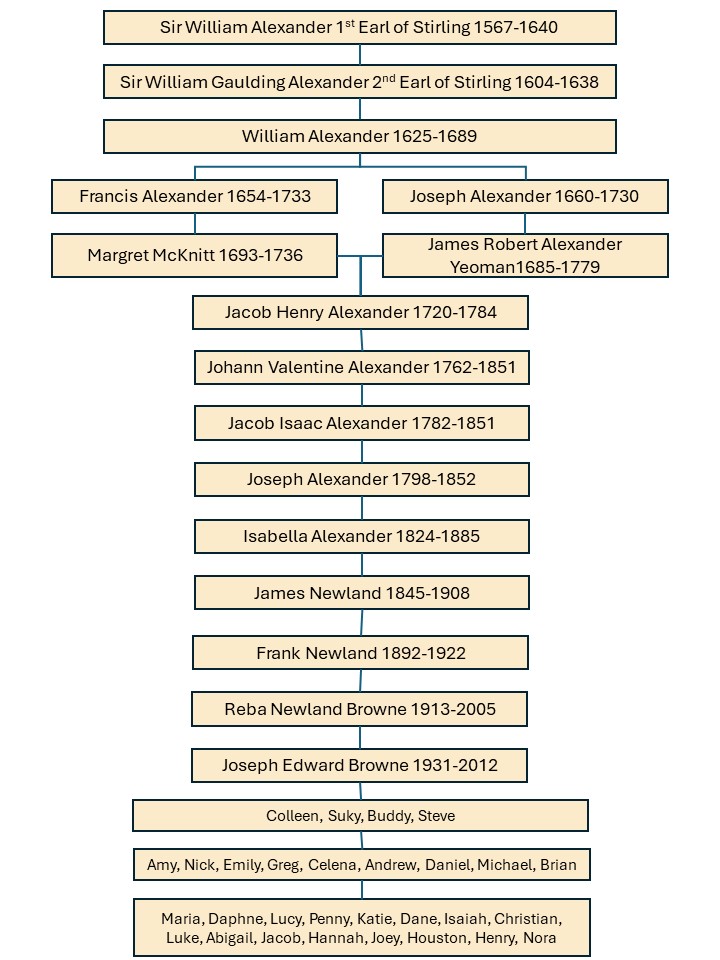
Margaret McKnitt (1721-1780) married Jacob Heinrich Alexander (1720-1784). They were both great grandchildren of William Alexander (1625-1689) making them first cousins twice removed. Jacob served in the Revolutionary War.
Jemima (1727-1797) married Thomas Sharpe and had three children. She moved with her brothers John and Hezekiah to Mecklenburg County in 1754. Her son John was a major in Armand’s legion of Light Dragoons in 1778.
Amos (1729-1780) was married to Sarah Mary Sharpe and had fourteen children. He served as a colonel in the Revolutionary Army and was injured in battle and later appointed a justice in Cecil County, MD. Two of his sons, Isaac and Walter also served in the Revolutionary war.
Two children, Jemima and Edith died young.
Theophilus, Abraham, Keziah, Jemima and Amos Alexander: 8th, 9th, 10th great aunts and uncles
Margaret McKnitt and Jacob Heinrich Alexander: 7th, 8th and 9th great grandparents
John McKnitt Alexander was the younger brother of Hezekiah (from the last post), and was the last child of James Robert (The Yeoman) Alexander and Margaret McKnitt. He was named after Margaret’s brother, a lawyer.
He married Jane Bain (also spelled Bane or Bean) and they had five children. He had moved from Cecil County, Maryland (or sometimes stated Pennsylvania since it is very close) with his brother Hezekiah and sister Jemima in 1754.
“His name is so conspicuous in the history of his country, that it is necessary to speak more at length of him and his family than many others of equal virtue, but who did not appear at the front so prominently in the stirring times of the last quarter of the Eighteenth Century. John McKnitt Alexander was born and reared in Pennsylvania, dating his birth in 1733, he was 21 years old when he came to Mecklenburg in 1754. He had learned the tailor’s trade while a minor, and followed this avocation for a number of years, taking cattle and hides in exchange for work, which he would carry to Philadelphia to find a market. There he would purchase broadcloth and other fine material to make into suits for the more wealthy class of his customers. He was also a surveyor, and it is more than probable that he surveyed the greater part of all the lands of the early settlers.
During one of his trips to Pennsylvania, in 1759, he married Jane Bain. He had built a home on what was afterwards known as the Statesville road, nine miles northwest of Charlotte. His house was the general rendezvous for the intelligent and patriotic for many miles in all directions. It was here the patriots were accustomed to meet and consider the condition of the country for months before the political climax was reached.
After much deliberate thought these patriotic pioneers agreed to meet in Charlotte as the most central point and give expression to their deliberations, where, on the 20th of May, 1775, the just celebrated Declaration of Independence was promulgated amid the shouts and huzzas of a populace fully prepared to indorse it with their lives, their fortunes and their sacred honor. Mr. Alexander being the Secretary of the Convention, was the custodian of all the documents and papers, including the ever memorable original draft of the Mecklenburg declaration, which was destroyed by the burning of his house in the year 1800.
Biographical sketches of the early settlers of the Hopewell Section…J.B. Alexander
(Many of his original minutes from the Convention also burned, making it more difficult to assess the authenticity of the Declarations)
An article from the Charlotte Observer dated May 20, 1775 says:
‘The secretary of the militia meeting has been John McKnitt Alexander, whose beautiful plantation home “Alexandriana” has been the scene of many a political meeting on the state of the colonies and the county these past few years.
“J. McKnitt” as he often styles himself is one of the most influential citizens of Mecklenburg. Six feet tall with high forehead and flashing black eyes – he addresses every gathering in a calm and deliberate but exceedingly earnest and emphatic manner”…. Alexander began earning his living as a tailor, but has been active, increasingly, in land sales and in surveying. He is one of the largest land owners in the county and is an elder in Hopewell Presbyterian Church.”
Of the possible 28 signers of the Mecklenburg Declarations, six were members of the Alexander family: John Mcknitt, Hezekiah, Adam, Abraham, Charles and Ezra. Here is a story about another of the signers:
Duncan Ochiltree was one of the original signers of the Meckenburg Declaration of Independence. Although Duncan Ochiltree was credited as being one of the original signers, his name was removed from all subsequent accounts of documents because he became a traitor by becoming a Quartermaster for the British. He owned a mercantile store as well as land, but he knew his fellow citizens would punish him for his change of heart and political leanings. According to Alexander, he begged John McKnitt Alexander to spare his life and protect him, after the British Army left the Charlotte area. John promised him protection while he was in his own home, but he advised him to leave the area immediately. Ochiltree reportedly fled to Wilmington and later moved to Florida. John McKnitt Alexander told his slaves, Cato and Ruth, to burn the stockyard and barn rather than give food and provisions to Ochiltree for the British. When this event he feared happened, Cato and Ruth did burn the building and year’s worth of farm work to ashes.
MeckDec Day (May 20) is still marked in North Carolina.
How to celebrate MeckDec Day — the best holiday in Charlotte — this weekend
Charlotte Observer 10/19/2016 (update)
An interesting aside to the story of the Alexanders in Mecklenburg County lies with their tangential association with the Regulators – the story of which was detailed in Benjamin Merrill’s post.
Here is an excerpt from: History of Mecklenburg County and the City of Charlottte, from 1740-1903 by D.A. Tomkins, 1903
“A number of Mecklenburg men were in the ranks of the Regulators, but as they had no organization among themselves, it is not possible to estimate their number. Mecklenburg people recognized the justice of the cause for which the Regulators shed their blood, but they did not deem it prudent to make open resistance to authority at that time. The Phifers, Alexanders, Polks and other prominent citizens were not the kind of men who strike without carefully considering the consequences, but from May 17, 1771, independence of thought steadily developed into independence of action. The young men were not so conservative as their fathers, and they did not hesitate to express sympathy for the men who were struggling against oppression. Col. Moses Alexander was commissary for General Waddell, and while his wagons, laden with powder, were passing through the county, they were captured and the powder was destroyed by nine boys who have since been known as “The Black Boys of Mecklenburg.” They blacked their faces and disguised themselves as Indians before attacking the wagons, and from this they gained their name. These boys were afterwards noble soldiers in the Revolution.”
This interpretation makes it seem as though the Alexanders and other prominent citizens of Mecklenburg County realized that the Regulators were fighting a just cause against the British and General Tryon, but at the same time wanted to stay somewhat out of it as the harsh regulations and taxes hadn’t hit them yet as Mecklenburg was a newer county. It is interesting to note that Moses Alexander (the son of John McKnitt Alexander) was commissary for General Waddell, the British general who was sidetracked by Benjamin Merrill earlier.
Hezekiah Alexander was one of eleven children of James Robert (The Yeoman) Alexander and Margaret McKnitt. He was married to Mary Ann Sample (1734-1805) and they had eleven children. He was the 5th great uncle of Reba’s father, Frank Newland.
He was born in Cecil County, Maryland, (at the very top and east of Maryland) where his grandfather had emigrated from Ulster, Ireland. He later moved to Mecklenburg, North Carolina, four miles east of where the city of Charlotte was founded. Their house was built in 1764 and is still standing.
On May 20, 1775 he was one of the signers of the Mecklenburg Declaration of Independence, which declares independence from England and predates the 1776 Declaration of Independence. There is some controversy about this document as it was not published until 1819, because it was apparently destroyed in a fire and recreated by John McKnitt Alexander (Hezekiah’s brother) and published. Many scholars no longer consider it authentic. Thomas Jefferson was adamant that it was not, as some of its phrasing echoed his own writing in the Declaration of Independence. John Adams initially supported its authenticity as he bore some resentment towards Jefferson for all the credit he received from authoring the Declaration, and ribbed him in a letter, implying that he may have borrowed some of the Mecklenburg turns of phrases. This incensed Jefferson and his strongly worded response convinced John Adams that the Mecklenburg Declaration was not authentic. This document had been a source of pride for North Carolina and they were in an uproar over this disrespect as they saw it.
Though the Declaration may not be authentic, the Mecklenburg Resolves are real. Written on May 31, 1775, they are not a declaration of independence but rather a set of resolves rejecting the laws of Parliament. Some feel that the controversy over the Declarations is pointless, as the Resolves themselves are quite a bold statement of the desire for independence.
A sad counterpoint to the desire for freedom and independence is the fact that Hezekiah and other men of the time denied freedom and independence to the people that they enslaved.
When speaking of the validity of the Declaration, historian Dan L. Morrill said, “Ultimately, it is a matter of faith, not proof. You believe it or you don’t believe it.” North Carolina chooses to believe it, as the state symbol and flag both continue to bear the date May 20, 1775 – the creation of their state’s alleged contribution to the movement toward American independence.
Here is an opposing opinion from William Henry Hoyt: Historians have generally concluded, however, that the document as it is now known is at best a later reconstruction drawing heavily on the language of the 4 July 1776 Declaration of Independence (PTJ, 1:429–33). A meeting in Mecklenburg County had indeed passed resolves suspending British rule on 31 May 1775, and the text above was composed by an unknown author basing his work on brief notes on those resolves written from memory in 1800 by John McKnitt Alexander.
The passage of twenty-five years likely explains the metamorphosis from what were probably more reserved resolutions into a so-called “declaration of independence” (William Henry Hoyt, The Mecklenburg Declaration of Independence: A Study of Evidence Showing that the Alleged Early Declaration of Independence by Mecklenburg County, North Carolina, on May 20th, 1775, is Spurious [1907]).
Here is an excerpt from J.B. Alexander’s book, “Reminiscences of the last sixty years ” about Hezekiah:
“I do not suppose of all the signers of the (Mecklenburg) Declaration of Independence, there was one superior in ability, or was more determined in severing the relations with the mother country than Hezekiah Alexander. He considered well the the course they were about to take; if the Colonies should not fall into the same line of thought with Mecklenburg country, their doom was sealed, and each one of them would pay for the crime of treason.”
History records the name of Hezekiah Alexander as an administrator and councilor. He held the post as Magistrate from the first appointed one in the county and historians have said “He was one of the most clear headed Magistrates in the County before the Revolutionary War and following the Declaration of Independence was named one of the members of the State Councul [sic] of Safety. In the Revolutionary War he was the paymaster for the 4th Regiment of North Carollina Troops, then became 1st lieutenant in 1777, and retired June 1st, 1778.
Mini biographies of Scots and Scots Descendants
Here is an excerpt from “The History of Mecklenburg County, by J.B. Alexander:
(Hezekiah’s) old house has a great cavern of a cellar where tradition says Mrs. Hezekiah Alexander used to store the rich products of the farm, many jars of honey being part of their contents. Just in front of the cellar door is, or used to be, a large flat stone; and upon this stone the British soldiers broke all the jars of honey which they could not carry away with them. They would not leave anything for the old rebel and his family. There is a beautiful spring near the house with a stone arch built over it, a stone spring house for dairy purposes, whose size indicates that milk, butter and cheese must have been so abundant as to require considerable room.
One of the unusual proofs of Hezekiah’s love of religious freedom was a carving of a fish on his house, the secret symbol, which Presbyterians used in Scotland and Ireland to signify allegiance to the Presbyterian faith.
… Tradition states that the two daughters of Hezekiah Alexander were very beautiful women. Mrs. Captain Cook, who was deputed by the town to entertain Gen. Washington when he was the town’s guest in 1791, was considered a good judge of female beauty, having seen much of the world and she said she had never seen any beauties who equaled these two Misses Alexander. One of them married Charley Polk and met a very tragic fate. Her husband was cleaning his gun in her room (where she was sitting with her child in her arms), when it went off and killed her. He subsequently announced his intention of marrying his beautiful sister-in-law but her brothers objected very decidedly, and his own brothers also interfered to prevent the marriage, and he had to give it up.
It was necessary at times for Mary Alexander to hide her sons in the weeds to prevent them from being kidnapped by the British soldiers and used as hostages.
From the day when maurading [sic] Indians, killed the settlers; to the day when Tory neighbors informed the enemy where supplies could be obtained by foraging; to the days when the British Soldiers burned homes and confiscated personal belongings, Hezekiah Alexander remained calm and led the people of his community toward a just peace.
William W. Alexander (1842-1863) was the uncle of Frank Newland (Reba’s father). His parents were Catherine Kingery and Joseph Alexander.
He enlisted as a private in the 8th Infantry, Company B of the Union army on August 25, 1861 in Greenfield Indiana.
He died on July 25, 1863 at Memphis, Tennessee. The report says that his arm was amputated, and then he died. He is buried in the Mississippi River National Cemetery, Memphis, Tennessee.
The battle he died in is not mentioned, but it was likely the Tullahoma Campaign, in which the Union general, General Rosecrans forced the Confederate troops under General Bragg across the Tennessee River – allowing the Union conquest of central Tennessee.
John Hennessy (1784-1833) and Mary Hayes (1781-1831) had fifteen children (he had one child, Michael, with a previous wife Catherine). Of these fifteen children, nine remained in Ireland and six emigrated to America because of the famine.
Winifred, who was married to Michael Browne, emigrated with her family to New Orleans in 1823. (last post)
Mary (1812-1852) stayed in Ireland – she died in Clonmult, County Cork.
Patrick (1815-1897) married Anne Godfrey and from the census records it looks like they were in Cornwall England in 1851, then Leon Texas in 1860, Pennsylvania in 1880, and either died in Ontario, Canada, or Pennsylvania. They had one daughter, Catherine Sophia who travelled to Australia at the age of 23, apparently alone. It’s not clear why she travelled to Australia from her home in Ireland, but it may be that she was already betrothed and meeting her future husband, George Atkins Whitaker there. They married and later he had an unfortunate mishap ending in his death – there is an account by a young man who saw him walking, asked if he would like a ride in his horse cart, to which George agreed. Apparently they then had a bit or more to drink, later the cart capsized and they both fell out – George said he wanted to stay where he was so his friend propped him against a fence and he apparently died during the night. He and Catherine had several children whose descendants are still in Australia and New Zealand.
Alice (1820-1905) married a Timothy Hennessy, and and they had ten children. They first emigrated to Wisconsin, where they lived in 1860, and then she later moved to Georgia, and died in Savannah.
Timothy (1820-1890) remained in Ireland – County Tipperary.
Michael (1821-1911) remained in Ireland. He died in Clonmult, County Cork.
Arthur (1822-unknown). It’s not known where he lived, but it was most likely in Ireland.
Dennis (1824-1903) first landed in New Brunswick in 1849 with his wife Catherine and daughter, Mary, age 3. They then went on the steamship Commodore to Portland and Falmouth, Maine, and then on to New York in 1853. They first settled in Pennsylvania, and then in the 1880s moved to Wisconsin. They had ten children in all.
Dennis and Catherine Haley Hennessy
John (1825-1895) stayed in Ireland.
Eliza (1826-unknown). It’s unknown but likely she stayed in Ireland.
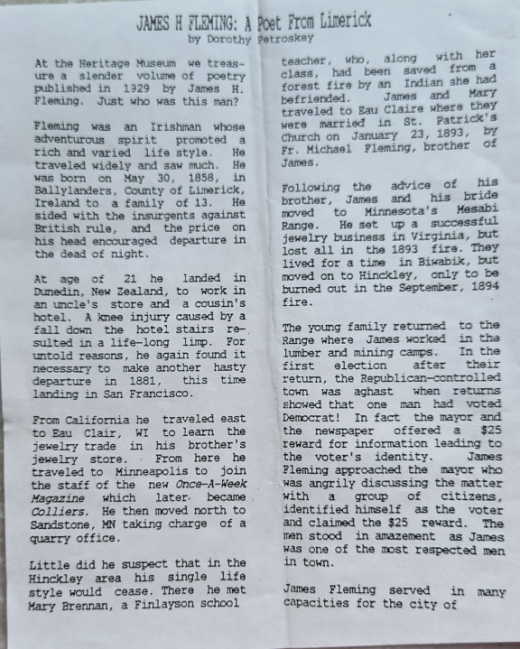
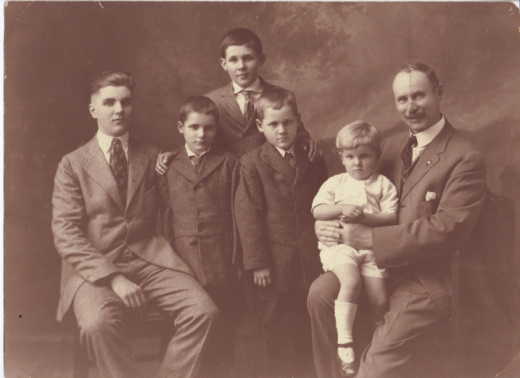
MaryAnne (1826-1890) She stayed in Ireland and married Thomas Fleming. They had ten children, and of them two ended up in Chicago, two in Wisconsin, two in Michigan, one in Texas and one in Indiana. (Two died as children in Ireland). Some of their children were John (Big Jack), a sheriff and an undertaker in Wisconsin, Father Michael Fleming in Michigan, Hannah, who was with the Sisters of Providence in Terre Haute, IN, and James (see below).
James (at right) with his family
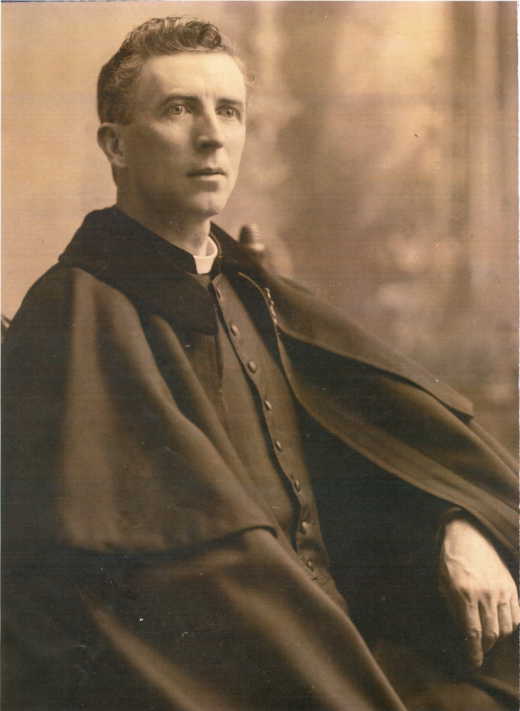
Father Michael Fleming
Bridget (1828-1898) stayed in Ireland. She died in Clogheen.
Margaret (1828-1915) married John Evans and they had four children. They emigrated to Savannah, Georgia.
James (1830-1867) stayed in Ireland. He died in Shillelagh.
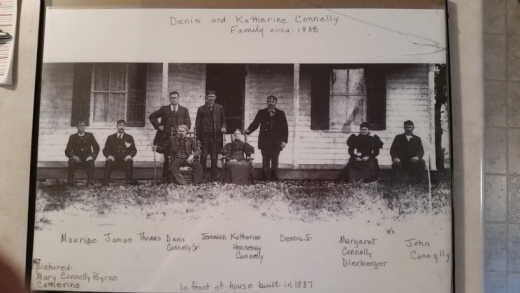
Catherine (1831-1913) married Denis Connelly in 1855. They had nine children and emigrated to Le Sueur, Minnesota.
Catherine Hennessy Connelly seated in the middle with her family.
John and Mary Hayes Hennessy were our 4th, 5th, and 6th grandparents.
The other Hennessys were our 4th, 5th, and 6th great aunts and uncles, except for Winifred who was our 3rd, 4th and 5th great grandmother.
The Flemings and other children of the Hennessys were our first cousins 4, 5, and 6 times removed.
Michael (1809-1852) and Winifred (1812-1884) were both from Ballylanders, County Limerick, Ireland. (The spelling of Winifred varies – sometimes it is written as Winnefred, and on her tombstone is spelled Winefred, but is most often spelled Winifred. She also appears to have gone by Winnie).
They were the parents of John Thomas and maybe six other children – it’s not completely clear. The information we have about them comes from a letter written by their granddaughter, Jane Browne Glass.
What we know about Michael is sketchy, only that he was a farmer whose elderly uncle was a priest who lived with him and Winifred in Ireland, and apparently admonished Winifred about attending daily mass. Michael and Winifred sold their belongings after their third potato crop failure and boarded a ship headed to New Orleans in 1852. Michael was 43, and Winifred 40. With them were seven children, according to the ship’s manifest: James, 20, Margaret, 14, Bridget, 12, Michael, 11, (probably the baby – maybe 11 months?), Dennis, 9, Mary, 5, and Sarah, 3. These were the names on the ship’s record, but it oddly doesn’t include their other children, John Thomas, age 6, Johanna, 9, and Thomas 12. Whether the mistakes are in the ship’s record or the ancestry record isn’t clear. James, Bridgett, and Sarah only appear on the ship’s record, so that does seem like it might be in error, and they may have been someone else’s children, or just had the names wrong.
Michael fell ill on board the ship and died a few weeks after arriving. He did fill out naturalization papers though, so must have been hopeful for the future. Their baby, also named Michael, died on board and was buried at sea.
Here is an excerpt from the website Irish American Journey:
Traveling to America by ship during the Irish Famine could be quite perilous. In the mid-19th century, English landlords looking to evict penniless Irish tenants would pay to have them shipped to British North America. In many cases these ships were poorly built, crowded, disease-ridden, and short of food, supplies and medical services. As a result, many Irish immigrants contracted diseases such as typhus, and many others died before reaching land. Of the 100,000 Irish that sailed to British North America in 1847, one out of five died from disease and malnutrition. Appropriately, these treacherous sailing vessels became known as “coffin ships.”
Most of the ships carrying Irish immigrants to America, however, were well built and adequately supplied. And although sailing across the Atlantic in the 19th century presented many challenges, most Irish ships brought Irish immigrants safely to America to begin their new lives.
irishamericanjourney.com
Winifred was left to fend for herself and her children in New Orleans. They had originally planned to go to her uncle’s house (Dr. Patrick Hayes, a herbal doctor and farmer in Madison County, Texas), but when Michael died she had to put the children in an orphanage and try to find work. The letter from Jane Browne Glass says she was left with five children and 95 cents.
Eventually her uncle came and took her and the children on a boat to Galveston and then another boat up the Trinity River to Cairo (Texas). She and the children were ill with possibly yellow fever (recurring fever and chills) and Winnie remembered the priest’s admonitions about attending mass, and when her nephew John Hennessy from Houston came to check on them, they all piled into his wagon and moved to Houston so they would be closer to a Catholic church.
They stayed for a while with her brother Tom, until she rented a house and she and her eldest daughter learned the dressmaking business. Her oldest child, Thomas (16) was living with another family “in the country”, and Winifred received word that he had died – she never found out when or how. The letter states she found it hard to recover from this latest sorrow.
During the Civil War, life was difficult and they lived with a Mr. and Mrs. Cunningham who had a school that the children attended, and Winifred did the housework.
After the war, she bought land and built a home at the corner of Rush Avenue and Jackson Street where she lived until her older years when she went to live with her daughter Margaret.










 Duke City Roots