Michael (1809-1852) and Winifred (1812-1884) were both from Ballylanders, County Limerick, Ireland. (The spelling of Winifred varies – sometimes it is written as Winnefred, and on her tombstone is spelled Winefred, but is most often spelled Winifred. She also appears to have gone by Winnie).
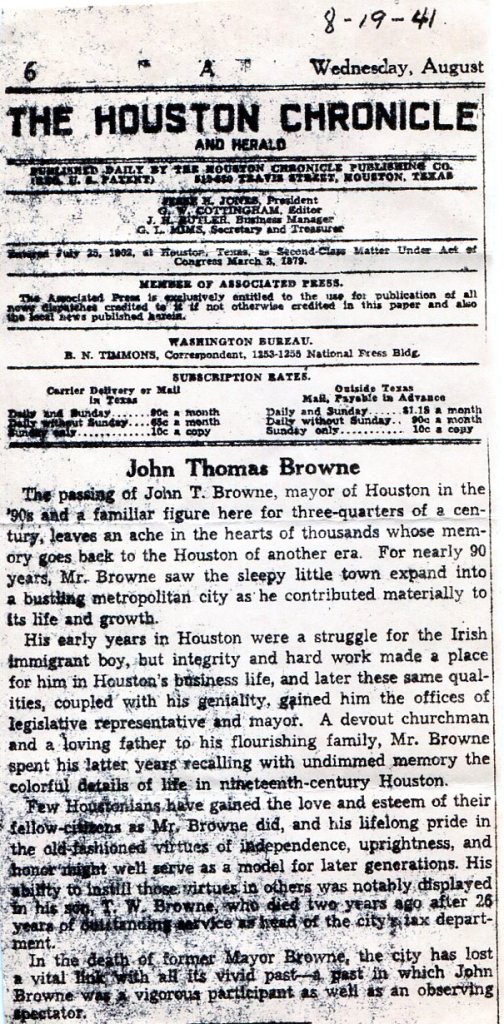
They were the parents of John Thomas and maybe six other children – it’s not completely clear. The information we have about them comes from a letter written by their granddaughter, Jane Browne Glass.
What we know about Michael is sketchy, only that he was a farmer whose elderly uncle was a priest who lived with him and Winifred in Ireland, and apparently admonished Winifred about attending daily mass. Michael and Winifred sold their belongings after their third potato crop failure and boarded a ship headed to New Orleans in 1852. Michael was 43, and Winifred 40. With them were seven children, according to the ship’s manifest: James, 20, Margaret, 14, Bridget, 12, Michael, 11, (probably the baby – maybe 11 months?), Dennis, 9, Mary, 5, and Sarah, 3. These were the names on the ship’s record, but it oddly doesn’t include their other children, John Thomas, age 6, Johanna, 9, and Thomas 12. Whether the mistakes are in the ship’s record or the ancestry record isn’t clear. James, Bridgett, and Sarah only appear on the ship’s record, so that does seem like it might be in error, and they may have been someone else’s children, or just had the names wrong.
Michael fell ill on board the ship and died a few weeks after arriving. He did fill out naturalization papers though, so must have been hopeful for the future. Their baby, also named Michael, died on board and was buried at sea.
Here is an excerpt from the website Irish American Journey:
Traveling to America by ship during the Irish Famine could be quite perilous. In the mid-19th century, English landlords looking to evict penniless Irish tenants would pay to have them shipped to British North America. In many cases these ships were poorly built, crowded, disease-ridden, and short of food, supplies and medical services. As a result, many Irish immigrants contracted diseases such as typhus, and many others died before reaching land. Of the 100,000 Irish that sailed to British North America in 1847, one out of five died from disease and malnutrition. Appropriately, these treacherous sailing vessels became known as “coffin ships.”
Most of the ships carrying Irish immigrants to America, however, were well built and adequately supplied. And although sailing across the Atlantic in the 19th century presented many challenges, most Irish ships brought Irish immigrants safely to America to begin their new lives.
irishamericanjourney.com
Winifred was left to fend for herself and her children in New Orleans. They had originally planned to go to her uncle’s house (Dr. Patrick Hayes, a herbal doctor and farmer in Madison County, Texas), but when Michael died she had to put the children in an orphanage and try to find work. The letter from Jane Browne Glass says she was left with five children and 95 cents.
Eventually her uncle came and took her and the children on a boat to Galveston and then another boat up the Trinity River to Cairo (Texas). She and the children were ill with possibly yellow fever (recurring fever and chills) and Winnie remembered the priest’s admonitions about attending mass, and when her nephew John Hennessy from Houston came to check on them, they all piled into his wagon and moved to Houston so they would be closer to a Catholic church.
They stayed for a while with her brother Tom, until she rented a house and she and her eldest daughter learned the dressmaking business. Her oldest child, Thomas (16) was living with another family “in the country”, and Winifred received word that he had died – she never found out when or how. The letter states she found it hard to recover from this latest sorrow.
During the Civil War, life was difficult and they lived with a Mr. and Mrs. Cunningham who had a school that the children attended, and Winifred did the housework.
After the war, she bought land and built a home at the corner of Rush Avenue and Jackson Street where she lived until her older years when she went to live with her daughter Margaret.

Michael and Winifred Hennessy Browne
3rd great grandparents
4th great grandparents
5th great grandparents
I







 Duke City Roots