Ebenezer Folsom (1743-1814) was born in Rowan County, North Carolina. He was the 3rd great grandfather of Reba (Granny), on her father’s side.
Ebenezer first married a Choctaw woman, Ni Ti Ka Tehani in 1780, and they had two daughters, Rhoda and Sophia. Ni Ki Ta may have died after giving birth to Sophia, and it seems that Ebenezer placed Sophia in the care of his brother Nathaniel and married Sarah Paul and then moved to Arkansas and married Mary Leard. He and Sarah had one child, Miguel, and he and Mary had at least one child, Ebenezer B. Folsom who had a daughter, Jane, who was Reba’s great grandmother.
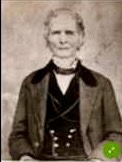
Ebenezer Folsom
His son wrote of his father “My father was a man of fine personal appearance; he was very energetic and enterprising and a man of extraordinary judgement. He emigrated from Louisiana to Texas A. D. 1838, the same year I was born.”
Ebenezer had gone to Mississippi with his family when young – his brother Nathaniel said that “their father (Israel) wanted to go there to get money – they say it grows on bushes there.” Ebenezer lived in the Choctaw and Chickasaw nations with his family, and then later ran away and moved in with Nathaniel who had earlier run away himself and moved there, and that is when he married Ni Ki Ta. Nathaniel married two Choctaw sisters and had twenty four children.
Ebenezer and Ni Ki Ta’s daughter Sophia also known as Li Lo Ha Wah (1773-1871) married Major John Pitchlynn (1765-1835) He was born in a boat offshore the island of St. Thomas, where his parents had traveled from England. His father Isaac was an officer in the English army. Isaac died when traveling in Choctaw country and John was raised by the Choctaws.

Sophia Folsom Pitchlynn
The following is from Wikipedia about John Pitchlynn:
“He first served as an interpreter at the Treaty of Hopewell. Under George Washington, he was appointed as an interpreter and head of the Choctaw Agency after approval by Benjamin Hawkins. He continued to serve under President Andrew Jackson. Pitchlynn served as an interpreter at the Treaty of Fort Confederation and the Treaty of Mount Dexter and was present at the signings of the Treaty of Doak’s Stand and Treaty of Washington City.[1]“
In 1830, Congress passed the Indian Removal Act, allowing for the removal of the Choctaws and many other tribes from their native lands and moving them west of the Mississippi River.
Excerpts from “Removing the Heart of the Choctaw People: Indian Removal from a Native Perspective.” Full reference below
In 1830 the Choctaw Nation occupied some of the most fertile lands in
North America. In the heart of what would become the Cotton Kingdom, the
Choctaws’ lands encompassed most of the Mississippi delta lands of Mississippi, as well as regions of Alabama and Louisiana. According to Choctaw traditions, these lands had been Choctaw lands forever, given to them by the Great Spirit, Chitokaka. The Choctaws resided in villages along rivers and streams, where they followed a primarily agricultural and sedentary lifestyle.
The 1820s saw the rise of Andrew Jackson to national prominence. He was
extremely popular in the backwoods areas of the American South, where he
consistently called for the expulsion of the resident Native nations.
The Choctaws were confident, because of their traditional expectations of the behavior of allies and friends, that the American government would stem the incursions into their lands, and would guarantee, as promised, their continued sovereignty and territorial integrity. Despite Jackson’s long personal history with the Choctaws, however, he now formed the core of those calling for their dispossession and exile.
Indian Removal, as the whites termed it, created moral and spiritual crises
intimately linked to fundamental Choctaw beliefs about place, origin, and
identity. Choctaws had a deep spiritual and physical attachment to the earth.
The Choctaws tried to convey the imperative reasons that they remain in
the lands of their ancestors to the U.S. agents and government. They could
not understand the whites’ assertion that they took the Choctaws’ well-being
to heart as they forced them away from that which gave them life. One old
man haltingly attempted to impart some understanding of their dilemma to
an American agent. He said, “We wish to remain here where we have grown
up as the herbs of the woods, and do not wish to be transplanted into another soil.” The Choctaws saw themselves as part of the soil, an integral element of the ecosystem, tied inextricably to this specific part of the earth. Their world was a vast, complex system of life and spirits, all comprising an indivisible whole. Like the old man’s herbs, the Choctaws believed they could not be separated from their mother, the land of which they were a part.
The journey to the West was characterized by American ineptitude,
incompetence, and fraud. Many Choctaws died or became seriously ill due to
exposure, disease, and inhumane arrangements for their journey. Most of the
nation was forced to walk the entire journey, which was more than five hundred miles.
Nearly one-third of the Choctaw Nation died on the march west. Many of
these were young children and elderly tribespeople, who disproportionately suffered from exposure, hunger, and disease.
The story of the American policy of Indian Removal must be reexamined
and retold. It was not merely an official, dry, legal instrument as it often is portrayed. Removal, as experienced by Native people, was an official U.S. policy of death and destruction that created untold human pain and misery. It was unjust, inhuman, and a product of the worst impulses of Western society. Indian Removal cannot be separated from the human suffering it evoked—from the toll on the human spirit of the Native people.
AMERICAN INDIAN CULTURE AND RESEARCH JOURNAL 23:3 (1999) 63–76
Removing the Heart of the Choctaw
People: Indian Removal from a Native
Perspective
DONNA L. AKERS
In the Library of Congress you can find letters between John Pitchlynn and President Andrew Jackson.
President Jackson wrote:
” I beg of you to say to them, that their interest happiness peace & prosperity depends upon their removal beyond the jurisdiction of the laws of the State of Mississippi. These things have been [often times] explained to them fully and I forbear to repeat them; but request that you make known to them that Congress to enable them to remove & comfortably to arrange themselves at their new homes has made liberal appropriations. It was a measure I had much at heart & sought to effect, because I was satisfied that the Indians could not possibly live under the laws of the States. If now they shall refuse to accept the liberal terms offered, they only must be liable for whatever evils & difficulties may arise. I feel conscious of having done my duty to my red children and if any failure of my good intention arises, it will be attributable to their want of duty to themselves, not to me.”
Muriel H. Wright, in “A Chieftain’s Farewell to the American people” American Indian 1, 1926, gives an excerpt from a song sung by the Choctaw people who stayed behind in Mississippi, mourning those who had left.
Hinaushi pisali, Bok Chito onali, yayali.”
[I saw a trail to the big river and then I cried.]
Here is an article about Sofia from the 405 Magazine:
The mother of Choctaw Chief Peter Pitchlynn and mother-in-law of Chief Samuel Garland, she was a woman of means who hoped to perpetuate her legacy.
She was born two days after Christmas 1773 to Ebenezer Folsom, a trader and interpreter whose ancestors emigrated from England in the 1630s, and his Choctaw wife.
Her father’s brother, Nathanial Folsom, married two Choctaw sisters – nieces of Miko Puskush, chief of the tribe’s Northeastern District – with whom he fathered 24 children. Each of them was a first cousin to Sophia and, like her, half-Choctaw.
One of the cousins, Rhoda Folsom, married John Pitchlynn. He arrived in the Choctaw Nation in present-day Mississippi with his father at the age of 10, becoming fluent in the language and staying with the tribe after his father’s death. He would go on to work as an interpreter and mediator for the U.S. government for nearly half a century.
Major John Pitchlynn fathered three sons in 10 years of marriage to his first wife. After her death, he wed Sophia Folsom and fathered another three sons, plus five daughters.
His influence increased over the years. His holdings grew to include livestock, 50 slaves, 200 acres of corn and cotton under cultivation and part-ownership of a stage line, making him one of the wealthiest men in the Choctaw Nation prior to Removal.
The family’s political strength also expanded. John and Sophia Pitchlynn’s eldest daughter, Mary, would marry Samuel Garland, chief of the Choctaws from 1862-64. Their eldest son, Peter Perkins Pitchlynn, succeeded Garland as chief for a two-year term.
John Pitchlynn signed the Treaty of Dancing Rabbit Creek in 1830. According to the Mississippi Encyclopedia, he and his sons Peter, John Jr., Silas and Thomas received 5,120 acres reserved in the Indian Territory. After liquidating most of their assets in anticipation of Removal, John and Sophia Pitchlynn opted to remain in the Old Choctaw Nation, where he died May 20, 1835.
Sophia migrated west to Indian Territory two years later. A house was built for her next to the two-story home of her daughter and son-in-law, the Garlands, who established a sawmill and cotton plantation.
An Oklahoma story in stone/M.J. Alexander. April 10, 2019
The above article states that Rhoda was Sofia’s cousin, daughter of Nathaniel, but in reality it seems that she was her sister.
One of Sophia and John’s sons, Peter Pitchlynn was also prominent in the Choctaw nation.
“Peter grew up in the traditions of the Choctaw, but desired a formal education as well. He attended school in Tennessee where he had to defend himself against the bullies who teased him for being an Indian. Pitchlynn would stand up for what he believed was right for the rest of his life.
He was home from school when the Choctaw National Council was holding a treaty negotiation regarding their removal from Mississippi. The government negotiator was General Andrew Jackson. Peter believed the treaty was wrong for the Choctaws and created quite a stir by refusing to shake hands with the famous officer.”
“A prominent Choctaw leader during the removal period, Peter Pitchlynn played a major role in building the national tribal government in the nineteenth century.
Pitchlynn thrived as a farmer, stock raiser, slave owner, and member of a small landed elite. Active in tribal affairs, he allied with Moshulatubbe against the missionaries and Greenwood LeFlore. Despite his opposition to the Treaty of Dancing Rabbit Creek, he sold his land holdings, led an emigrant party west in 1831, and settled his family on the Mountain Fork River near Eagletown (in present McCurtain County, Oklahoma) in 1834.
In the postremoval era Pitchlynn emerged as an influential politician and diplomat. He helped reestablish the Choctaw Nation west of the Mississippi and establish a national school system. During frequent missions to Washington, D.C., he pushed Choctaw claims with the federal government and advocated settlement on behalf of Choctaws defrauded of their lands during removal [the Trail of Tears]
After he obtained his degree from the University of Nashville, Pitchlynn returned to his family home in Mississippi, where he became a farmer. The Choctaw were among the Southeast tribes that used enslaved African Americans as workers on their farms. [4]
While Pitchlynn originally owned slaves, he opposed other Choctaw slaveholders like Robert M. Jones and he felt an indifference towards the institution: following the Emancipation Proclamation in 1863, he willingly cast it aside without protest.[8]
Wikipedia

Peter Pitchlynn
Ebenezer and Mary Folsom 4th, 5th, 6th great grandparents.
Sofia Folsom Pitchlynn 5th, 6th, 7th great aunt (half great aunt?)
Peter Pitchylnn 1st cousin 5, 6, 7 times removed (half cousin?)



 Duke City Roots